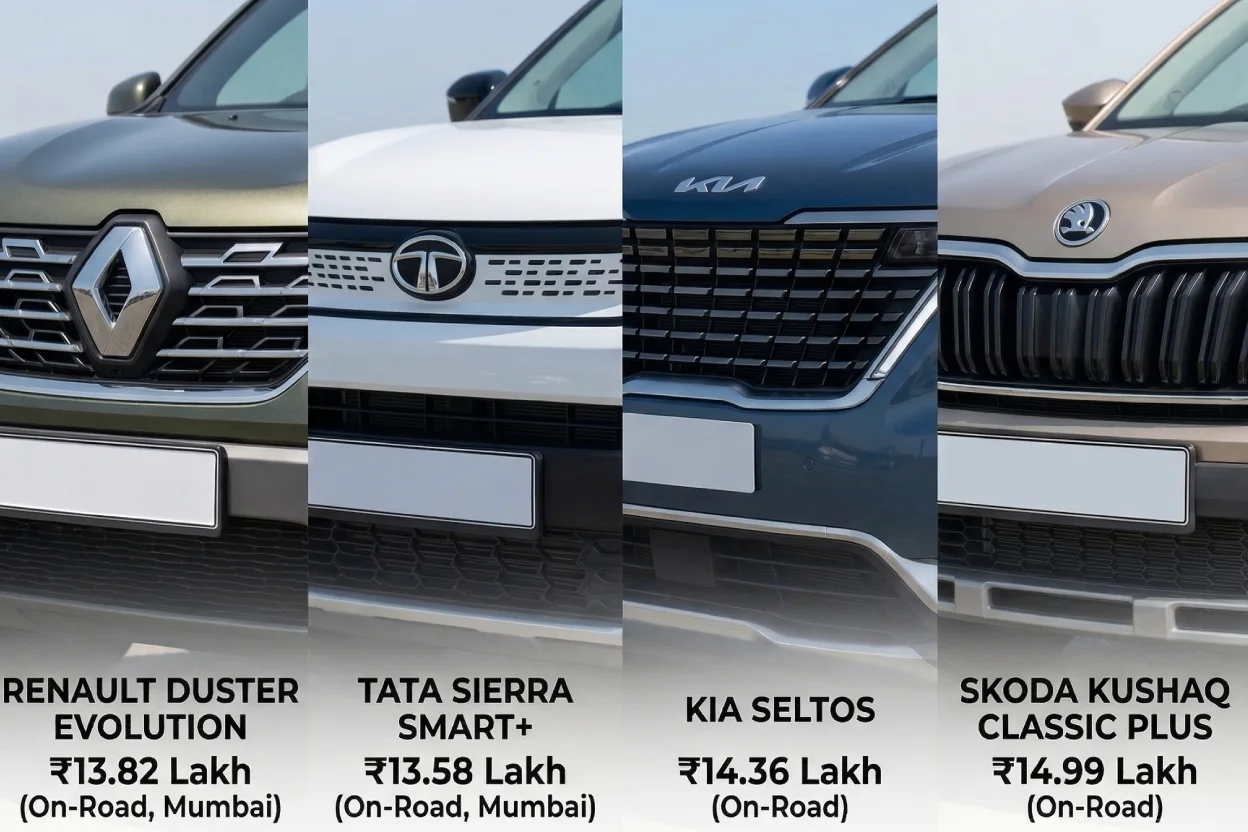
The Indian SUV market in 2026 is a strange place. EVs are growing, but petrol mid-sizers still dominate showroom traffic by a wide margin. And the ₹15 lakh on-road bracket has gotten interesting — not because the cars are perfect, but because automakers have stopped treating this price point as a dumping ground for base variants nobody actually wants.
These four make the strongest cases right now.
Renault Duster Evolution — ₹13.82 Lakh
The Duster is back, and it’s not embarrassing itself.
The original 2012 model had a suspension tune that swallowed bad tarmac better than most cars twice its price. The 2026 version keeps that. Same unhurried ride over broken roads, same useful ground clearance — not cosmetic ground clearance, actual clearance. And Renault hasn’t swapped the 17-inch alloys for steel wheels to cut costs, which is more than a few competitors can say.
The engine is where I’d slow down. A 1.0-litre turbo with 99bhp is fine around town, but put five people in the car with luggage and head for the expressway, and overtaking becomes something you plan in advance. If you mostly drive in cities, it’s a non-issue. If you regularly run long distances with a full car, it will eventually grind on you.
Tata Sierra Smart+ — ₹13.58 Lakh
The Sierra name carries nostalgia, but that’s not what makes this worth considering.
What makes it worth considering is a 5-star Bharat NCAP rating. Tata has been serious about structural safety for several years, and this car shows it. The body feels solid. Nothing flexes where it shouldn’t. For a segment where buyers often find out about safety compromises after the purchase, that matters.
The infotainment is a letdown. A 4-inch display in 2026 is hard to defend. If you rely on Apple CarPlay or Android Auto daily, this will irritate you far more than any powertrain compromise.
The 1.5-litre NA engine (104bhp) is predictable rather than exciting. It won’t win any comparisons on paper, but it’s the kind of engine local mechanics in smaller cities understand without a diagnostic computer. For a lot of buyers, that practical reality outweighs the spec sheet gap.
Kia Seltos HTE(O) — ₹14.36 Lakh
A sunroof under ₹14.5 lakh. That sentence is doing a lot of the work here, and Kia knows it.
Past the sunroof, the 1.5-litre NA engine (113bhp) is probably the smoothest of the four. Quiet, responsive, and easy to live with. The 5-star safety rating is also worth noting — earlier Seltos generations had structural critics, and that’s been addressed.
No automatic option at this price, though. For anyone stuck in significant stop-and-go traffic, that’s a daily tax the sunroof doesn’t offset.
Skoda Kushaq Classic Plus — ₹14.99 Lakh
Right at the budget ceiling, and the argument for it is almost entirely the 8-speed torque converter gearbox.
If you drive in city traffic for an hour each way, the difference between this and a 6-speed manual is not a spec sheet abstraction — it’s fatigue. The Kushaq’s claimed 19+ kmpl is also believable given the gearing. The steering and braking are tighter than the rest of the group, which you notice in corners.
The trade-off: some interior plastics feel like Skoda saved money there to fund the transmission. It’s the most expensive car here, so that stings a little.
The Numbers
| Feature | Duster Evolution | Sierra Smart+ | Seltos HTE(O) | Kushaq Classic Plus |
| Engine | 1.0L Turbo | 1.5L NA | 1.5L NA | 1.0L Turbo |
| Power | 99bhp / 166Nm | 104bhp / 145Nm | 113bhp / 144Nm | 114bhp / 178Nm |
| Gearbox | 6-Speed Manual | 6-Speed Manual | 6-Speed Manual | 8-Speed TC Auto |
| Safety | Expected 4-star (Global) | 5-Star (B-NCAP) | 5-Star (B-NCAP) | 5-Star (Global NCAP) |
| Notable for | Ride quality, alloys | Structural safety | Sunroof, refinement | Automatic gearbox |
| On-Road Price | ₹13.82L | ₹13.58L | ₹14.36L | ₹14.99L |
A Quick Note on How Far Things Have Come
The original 2012 Duster: two airbags, CD player, B0 platform. The 2026 model: six airbags standard, far better NVH, emissions hardware that meets current norms. The original Sierra was a three-door oddity with a big diesel. The 2026 version is a five-door family car with electric steering. They share names and not much else.
So, Which One?
The Duster Evolution is the most grounded of the four — real ground clearance, a suspension tune that works on actual Indian roads, and no pretension about what it is. Good pick if you want a capable, unpretentious car and aren’t doing 500km highway runs every weekend.
The Kushaq is the best mechanical package, but only if you’re logging significant city kilometres. The 8-speed TC earns its price in traffic. On open roads with a manual preference, that advantage disappears.
Either way: check the interior plastics yourself before signing. A safety rating doesn’t tell you how the cabin feels after a year. Take a proper test drive — city roads, a stretch of broken surface, and at least 15 minutes of expressway. These engines feel different once you push them past 80kmph, and you should know which one you’re committing to.