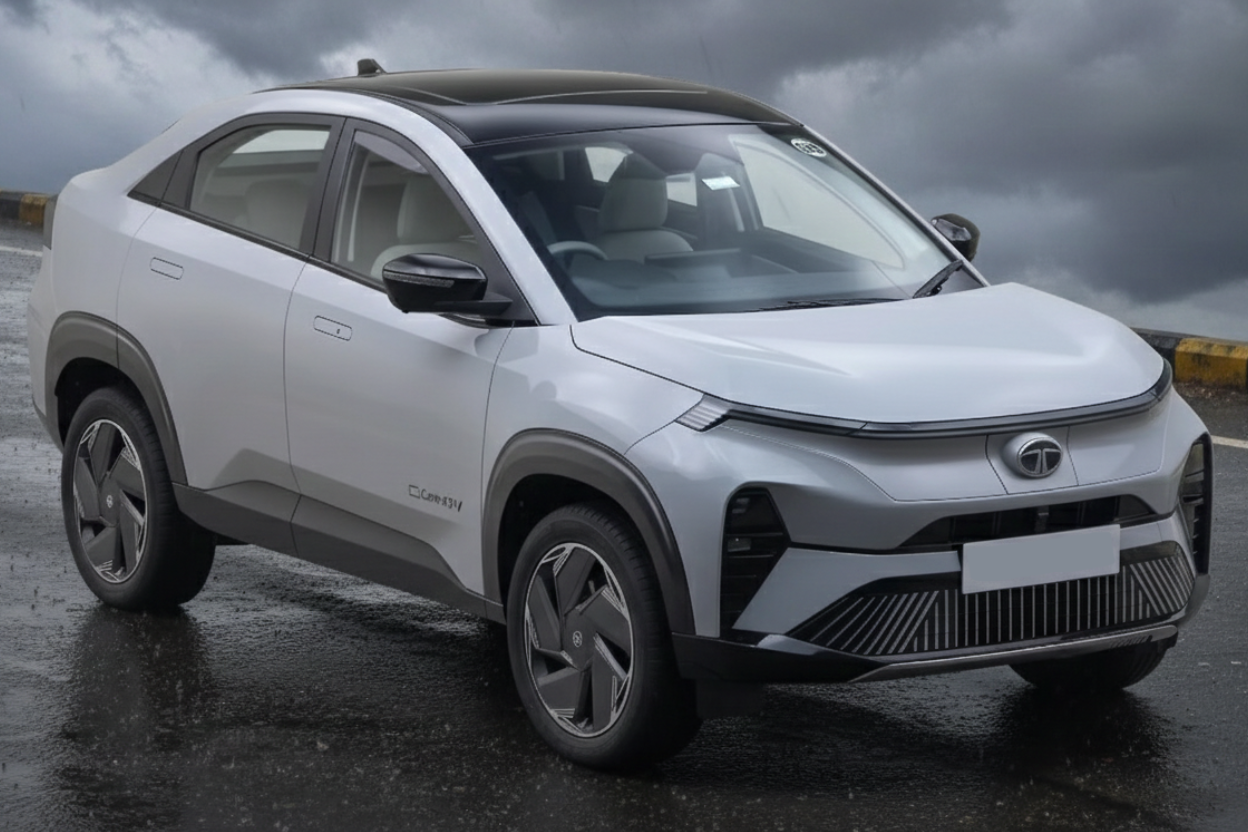
Making the jump from a traditional internal combustion engine (ICE) to a dedicated electric vehicle long-termer is always a bit of a psychological shift. We welcomed the Tata Curvv EV into our fleet toward the tail end of August, just as Mumbai’s monsoon was throwing its worst at the asphalt. Since then, this coupe-SUV has been a tireless workhorse, serving as a support vehicle for shoots and a daily commuter through the soul-crushing Mumbai traffic.
As of today, the odometer is nudging the 17,000 km mark, with my personal stint accounting for over 7,300 km. The “new car smell” and the initial novelty of that sloping roofline have faded, leaving me with a very objective, warts-and-all perspective on what it’s actually like to live with this marque.
The Economic Argument: Pennies vs. Pounds
In my opinion, the most jarring (and welcome) realization is the sheer impact on your wallet. Beyond the obvious fuel-to-electricity savings, the hidden “pro” for Mumbai residents is the toll exemption. Navigating the Atal Setu, Bandra-Worli Sea Link, and the Mumbai-Pune Expressway without shelling out toll fees has made my inter-city runs the most affordable they’ve been in a decade.
As per my knowledge, here is how the efficiency breaks down in the real world:
-
Average Range: 330 km (Real-world mixed usage).
-
Efficiency: ~6 km/kWh.
I have to be critical here: Tata’s insistence on using Wh/km as the primary metric is unnecessarily confusing. I would advise the automaker to stick to km/kWh; it’s the digital equivalent of km/l and far more intuitive for a driver to calculate on the fly. I also found that Regen Level 2 felt too intrusive and “grabby.” By switching to Level 1, the transition from acceleration to coasting became significantly more linear, and ironically, I managed to squeeze out slightly better range by maintaining momentum.
The Evolution: Curvv EV vs. The “Old Guard” (Nexon EV)
It is impossible to discuss the Curvv without looking at its older sibling, the Nexon EV, which essentially pioneered this chassis philosophy for Tata.
| Feature | Tata Nexon EV (Older Gen) | Tata Curvv EV (Current) |
| Platform | Gen 1 / Modified X1 | Acti.ev Dedicated Architecture |
| Body Style | Traditional Compact SUV | Coupe-SUV (Aerodynamic focus) |
| Charging Port | Manual Flap | Motorized (Electronic) Flap |
| Practicality | 350L Boot / No Frunk | 500L Boot / 11.6L Frunk |
| Wheel Size | 16-inch | 18-inch Aero-optimized |
My personal experience suggests that while the Curvv feels more premium, it has inherited some “beta-testing” vibes. The motorized charging flap on our unit failed almost immediately, forcing me to pry it open manually—a regression compared to the dead-simple manual flap on the older Nexon.
Driving Dynamics: A Tale of Two Speeds
On the open highway, the Curvv EV is a gem. It feels planted, and the acceleration is exactly what you’d expect from a high-torque electric transmission. However, once you enter the city, the cracks begin to show.
The 18-inch wheels look fantastic in a dealership showroom, but on Mumbai’s cratered roads, the ride is surprisingly fidgety. There is a persistent side-to-side “head toss” or bobbing motion. As per my opinion, the suspension tuning feels a bit confused—trying to manage the heavy battery weight while maintaining a sporty stance.
Furthermore, the braking feel is “wooden.” There’s a lack of progression in the pedal; it feels like nothing, nothing, and then everything. When you’re in heavy traffic, this lack of finesse makes for a jerky experience for passengers.
Segment Comparison: How It Stacks Up
The Curvv EV sits in an increasingly crowded supply chain of mid-size electrics. Here is how it compares to its primary rivals:
| Specification | Tata Curvv EV (55kWh) | MG ZS EV | BYD Atto 3 (Dynamic) |
| Battery Size | 55 kWh | 50.3 kWh | 49.92 kWh |
| Claimed Range | 585 km (ARAI) | 461 km | 410 km |
| Ground Clearance | 190 mm | 177 mm | 175 mm |
| Boot Space | 500 L | 448 L | 440 L |
| Disc Brakes | All 4 Wheels | All 4 Wheels | All 4 Wheels |
Cockpit Chronicles and Ergonomic Misses
Inside, the 12.3-inch infotainment screen is the star of the show, though it can be “moody.” I’ve had several instances where Apple CarPlay simply refused to handshake wirelessly.
I would advise potential buyers to be wary of the light-colored interior. While it feels airy, keeping it clean during a Mumbai monsoon is a full-time job. Also, for a company that literally owns Starbucks in India, the total absence of dedicated cupholders in the center console is a baffling R&D oversight.
Pro Tip: The 45W Type-C port is buried so deep in the lower center console that you practically need a flashlight and a parked car to plug in a cable. Do yourself a favor and leave a cable permanently plugged in.
The Verdict So Far
My six months with the Curvv have been a mix of admiration and mild frustration. The manufacturing quality is a step up, but small glitches—like the wheel alignment issue we’ve had since day one and the failing charge flap—suggest that quality control (SPC) still has some ground to cover.
That said, as a package, it’s an assertive attempt at a “lifestyle” EV. It turns heads at every gas station I pass (ironically), and the JBL sound system makes the daily grind bearable.