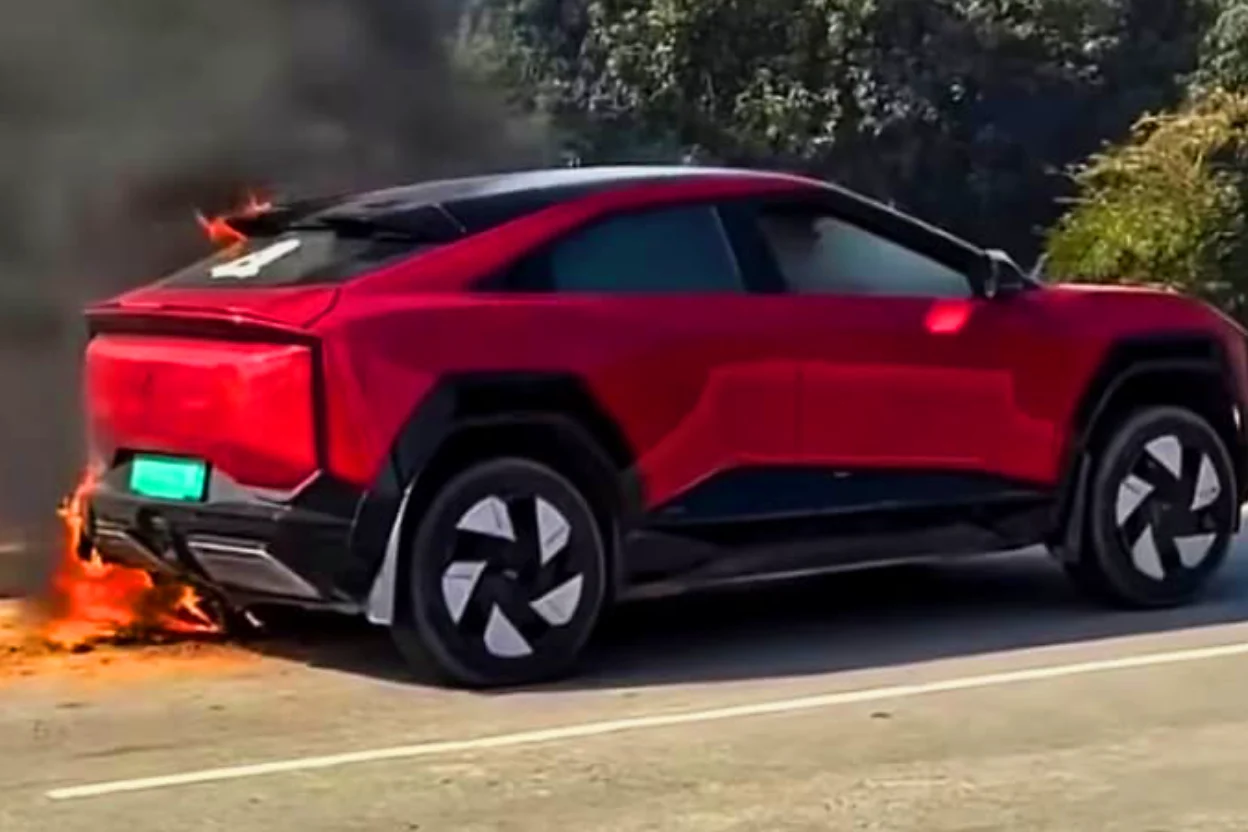
The automotive world recently hit a speed bump that has every EV enthusiast and skeptic leaning in. A Mahindra BE 6—the brand’s highly anticipated electric warrior—was caught on camera engulfed in flames near Gulaothi, Uttar Pradesh. Seeing a prototype from a marquee like Mahindra sidelined by fire is always a gut-punch for the R&D teams, but as someone who has followed the Indian manufacturing landscape for years, I believe there is a lot more to this “hot” topic than just a battery scare.
From my personal experience watching EVs evolve from the early e2o days to this sophisticated chassis, these incidents usually boil down to one of two things: a freak thermal runaway in the cells or, more commonly, extreme mechanical stress. According to the official statement from the automaker, this wasn’t a “spontaneous combustion” mystery. It was a case of a machine trying to save itself from human persistence.
The Anatomy of the Incident: When Alerts Go Ignored
As per the brand’s investigation, the root cause wasn’t the high-voltage transmission or a faulty battery pack. Instead, it was a deflated rear right tyre. Now, in my opinion, driving a heavy EV on a flat is like dragging a weighted sled across sandpaper.
Mahindra’s data logs show the vehicle was driven for roughly 10 minutes at speeds reaching 60kph despite a flat. The onboard sensors were screaming—sending alerts about low pressure and skyrocketing tyre temperatures. When you ignore these, the friction between the rim and the shredded rubber generates immense heat. This isn’t just a Mahindra issue; any vehicle, whether it has a carburetor or a permanent magnet motor, becomes a fire hazard under these specific conditions.
The Defensive Maneuvers of the BE 6
What I find fascinating from a quality control (SPC) perspective is how the car’s brain reacted:
-
Stability & Traction Control: The SUV kept engaging these systems to manage the erratic wheel spin caused by the lack of grip.
-
Electronic Limiting: The ECU eventually throttled the acceleration to prevent further damage.
-
System Shutdown: The drive system eventually cut power entirely to bring the model to a halt.
Unfortunately, by the time the body shop experts could look at it, the friction-induced heat had already crossed the point of no return.
Looking Back: The Evolution of Safety
To understand where we are, we have to look at the marque’s history. If we compare the current BE 6 (INGLO platform) with Mahindra’s earlier foray into electric mobility, the leap in R&D is staggering.
Comparison: Mahindra e2o (2013) vs. Mahindra BE 6 (2025/26)
As per my knowledge, the old e2o was a city runabout that lacked the complex sensor suites we see today. The BE 6 is a powerhouse, but the irony is that more sensors mean more warnings that drivers sometimes choose to ignore. In the old days, you’d feel a flat immediately because the suspension was basic; in modern, well-insulated SUVs, the chassis masks the vibration so well that you might rely too much on the screen rather than your “seat-of-the-pants” feel.
Rivalry in the Spark: BE 6 vs. The Competition
The Mahindra BE 6 enters a crowded dealership landscape, primarily squaring off against the Tata Nexon EV and the MG ZS EV. Interestingly, Tata faced a similar “trial by fire” in 2022 near Mumbai. It seems every automaker goes through this “baptism” as they scale up.
Segment Comparison Chart
I would advise potential buyers not to get spooked by these headlines. Whether you are looking at financing a Mahindra or leasing a Tata, the reality is that EV fires are statistically rarer than ICE (Internal Combustion Engine) fires. However, when they do happen, they are spectacular and headline-grabbing.
Predictive Analysis: What This Means for Mahindra
From a marketing and sales standpoint, this is a delicate moment. Mahindra is trying to position itself as the undisputed leader in the premium electric SUV space. A fire during testing or early deployment is a “calculated tactical maneuver” by fate to test their crisis management.
As per my opinion, Mahindra was smart to release the data logs quickly. By pointing to the deflated tyre and the 10-minute drive time, they are shifting the narrative from “faulty battery” to “operating outside of safety parameters.” In the world of quality control, this is a crucial distinction.
My Final Take
If you’re waiting for your BE 6 delivery, don’t cancel your booking just yet. This incident highlights that the axle, wheels, and braking systems are just as critical as the battery. We often focus so much on “range” that we forget basic vehicle maintenance like checking catalytic converters (in ICE) or tyre pressure (in EVs).
The manufacturing process for the BE 6 involves some of the most rigorous SPC (Statistical Process Control) standards in India. This fire seems to be a result of mechanical abuse rather than a fundamental design flaw in the engine (motor) or cells.