Let me be straight with you. When Skoda first rolled out the Kushaq back in 2021, I remember thinking — finally, a European automaker that’s actually trying in India. The MQB A0 IN platform felt genuinely well-engineered for Indian roads, the 1.5 TSI engine had real muscle, and the whole package carried a quiet, no-nonsense confidence that cars like the Hyundai Creta often sacrificed for flashy spec sheets. So when word got around that a facelift was incoming, I was curious. Excited, even. Now that it’s officially here, my feelings are… complicated.
Skoda has priced the 2026 Kushaq facelift between Rs. 10.69 lakh and Rs. 18.99 lakh (ex-showroom), spread across five variants — Classic+, Signature, Sportline, Prestige, and Monte Carlo. Deliveries are set to begin soon.
What’s Actually Changed Outside?
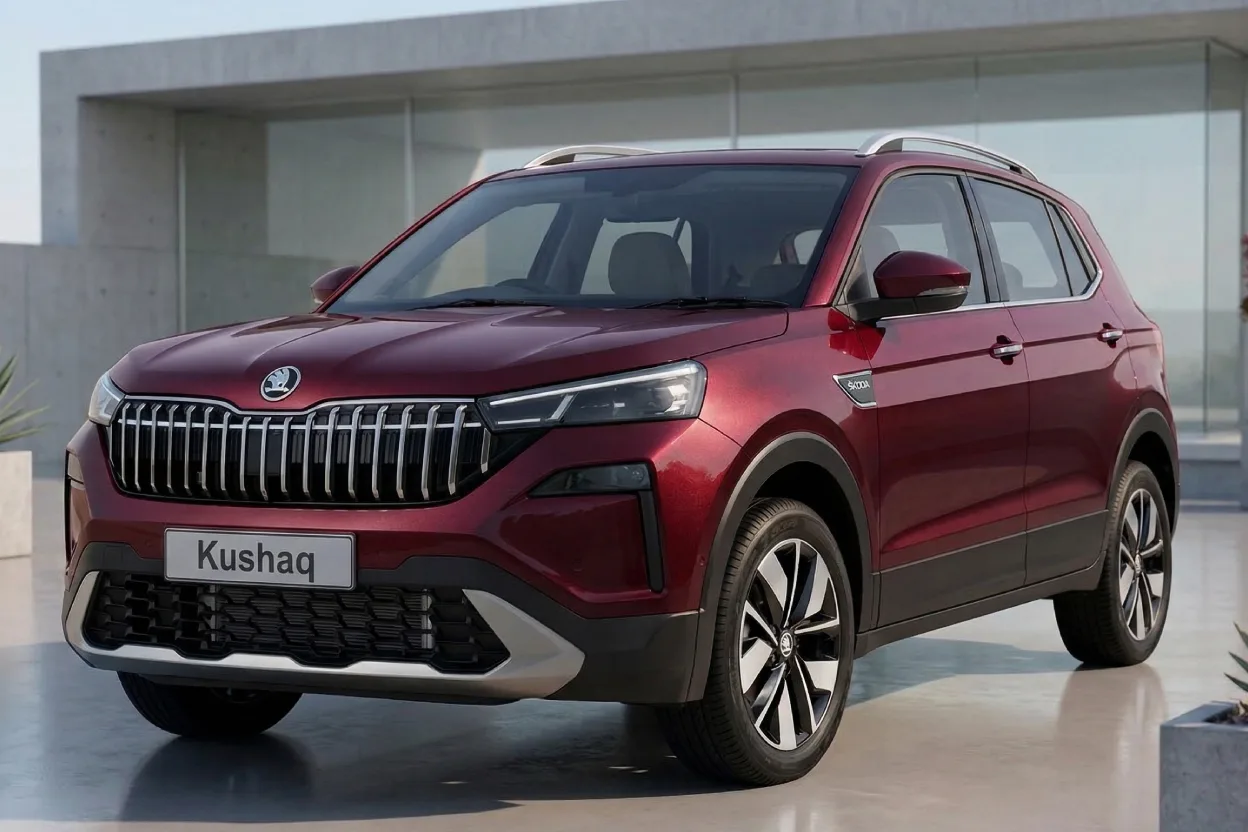
The front end gets a visual shakeup — redesigned LED headlamps, new DRL signatures stitched together through segmented lighting strips, a revised grille, and a bumper that’s been reshaped with sharper edges and metallic inserts. At the rear, the split LED tail lamps have been refreshed, and there’s illuminated lettering on the tailgate now — a detail that’s becoming more common in this segment but still adds a premium touch at night.
As per my knowledge of how Skoda engineers its facelifts, this isn’t a ground-up redesign. It’s what the auto industry calls a “mid-cycle refresh” — targeted cosmetic revisions to keep the model competitive without retooling the entire chassis or body shop. Whether that’s enough in a segment that’s gotten brutally crowded is a fair question.
Inside: More Than Just a Reskin
This is where I’ll give Skoda genuine credit. The cabin changes are more substantive than the exterior tweaks suggest. The Prestige and Monte Carlo trims now get a larger fully digital instrument cluster and an updated infotainment screen with Google-based assistant functionality — something competitors have had for a while, so Skoda was overdue here.
The upper trims also add ventilated front seats, electrically adjustable front seats, a panoramic sunroof, and a beefed-up audio system with a dedicated subwoofer. But the headline feature? A rear seat massage function — Skoda claims this is a segment-first, and from my personal experience tracking this space, I’d say that’s accurate. No other automaker in this price band is currently offering this through the factory assembly line.
The Monte Carlo holds on to its blacked-out exterior bits and red interior accents for the sporty crowd, while the Prestige goes the other direction — chrome detailing, a brighter cabin, more conventional premium appeal.
Variant & Price Breakdown
| Variant | 1.0 TSI MT | 1.0 TSI AT | 1.5 TSI DSG |
|---|---|---|---|
| Classic+ | Rs. 10,69,000 | Rs. 12,69,000 | — |
| Signature | Rs. 14,59,000 | Rs. 15,59,000 | — |
| Sportline | Rs. 14,74,000 | Rs. 15,74,000 | — |
| Prestige | Rs. 16,79,000 | Rs. 17,59,000 | Rs. 18,79,000 |
| Monte Carlo | — | Rs. 17,89,000 | Rs. 18,99,000 |
Dimensions at a Glance
| Parameter | Measurement |
|---|---|
| Length | 4,229 mm |
| Width | 1,760 mm |
| Height | 1,612 mm |
| Wheelbase | 2,651 mm |
| Ground Clearance | 188 mm |
| Boot Space | 491 litres |
The Mechanical Story — And the Big Transmission Change
Under the hood, the engine lineup is unchanged. You still get the 1.0-litre TSI (114 bhp, 178 Nm) and the 1.5-litre TSI (148 bhp, 250 Nm). What’s new is the gearbox configuration. The 1.0 TSI now pairs with a freshly introduced 8-speed torque converter automatic — replacing what was a 6-speed torque converter in earlier iterations — while the 1.5 TSI keeps its 7-speed DSG dual-clutch transmission.
| Specification | Details |
|---|---|
| Engine Options | 1.0-litre TSI / 1.5-litre TSI |
| Displacement | 999 cc / 1,498 cc |
| Power Output | 114 bhp / 148 bhp |
| Torque | 178 Nm / 250 Nm |
| Transmission | 6-speed MT / 8-speed AT / 7-speed DSG |
The 8-speed torque converter is genuinely a meaningful upgrade over the older 6-speed unit, particularly in stop-and-go city traffic where the DSG could sometimes feel jerky at low speeds. For buyers who want automatic convenience without the occasional hesitation of a dual-clutch, this is worth paying attention to.
The 1.5 TSI variant also picks up rear disc brakes — a proper safety and braking performance upgrade that the earlier model sorely needed. Six airbags come standard across all variants.
2026 Kushaq vs. The Pre-Facelift Model — What Actually Improved?
The original 2021 Kushaq was a solid car but had a few well-documented rough edges. Here’s where things stand now:
| Feature | Pre-Facelift Kushaq (2021–2025) | 2026 Facelift Kushaq |
|---|---|---|
| Headlamps | Standard LED setup | Redesigned LED with segmented DRL |
| Infotainment | 10-inch with basic connectivity | Updated with Google Assistant |
| Automatic Gearbox (1.0 TSI) | 6-speed torque converter | 8-speed torque converter |
| Instrument Cluster | Smaller semi-digital | Fully digital (Prestige/Monte Carlo) |
| Rear Brakes (1.5 TSI) | Drum | Disc |
| Ventilated Seats | Not available | Available on upper trims |
| Rear Seat Massage | Not available | Segment-first addition |
| 360-degree Camera | Not available | Still absent |
| ADAS | Not available | Still absent |
So yes, meaningful progress — but also two glaring omissions I’ll come back to.
How It Stacks Up Against Segment Rivals
Here’s where I’ll put the 2026 Kushaq facelift in proper context. This segment has gotten genuinely aggressive, and the Creta and Seltos in particular have raised the bar considerably:
| Feature | 2026 Skoda Kushaq | Hyundai Creta | Kia Seltos | Honda Elevate | Tata Sierra |
|---|---|---|---|---|---|
| Starting Price | Rs. 10.69 lakh | Rs. 11.11 lakh | Rs. 10.99 lakh | Rs. 11.69 lakh | Rs. 12.99 lakh |
| Top Variant Price | Rs. 18.99 lakh | Rs. 20.45 lakh | Rs. 20.45 lakh | Rs. 16.30 lakh | Rs. 19.49 lakh |
| Engine Options | 1.0T / 1.5T Petrol | 1.5N/A, 1.5T, 1.6D | 1.5N/A, 1.5T | 1.5 i-VTEC | 1.5T Petrol |
| ADAS | No | Yes | Yes | No | Yes |
| 360-degree Camera | No | Yes | Yes | No | Yes |
| Panoramic Sunroof | Yes | Yes | Yes | No | Yes |
| Ventilated Seats | Yes | Yes | Yes | No | Yes |
| Platform | MQB A0 IN | i20/Venue-based | SP2 | Honda Global | OMEGA-Arc |
| Rear Seat Massage | Yes (segment-first) | No | No | No | No |
The Two Things That Bother Me
As per my opinion, Skoda has done a competent job with this facelift. But I’d be doing you a disservice if I didn’t flag the two missing pieces that genuinely concern me.
No ADAS. The Hyundai Creta offers lane keep assist, forward collision warning, and driver attention alerting at comparable price points. The Kia Seltos does too. I would advise any prospective buyer to take this seriously — ADAS isn’t just a spec sheet checkbox anymore. On Indian highways, these systems have real-world safety value, and Skoda’s decision to skip it entirely on the facelift is a cost-saving move dressed up as indifference.
No 360-degree camera. At Rs. 17+ lakh, buyers deserve a surround-view system. Full stop.
These aren’t nitpicks. At this price band, the Kushaq is competing against cars that offer both, and Skoda knows it.
The Manufacturing Backbone
The facelifted Kushaq continues rolling off the assembly line at Skoda Auto Volkswagen India’s Chakan facility near Pune — a heavily localised production setup built on the MQB A0 IN platform that Skoda and VW jointly developed for South Asian markets. High localisation levels have historically kept the cost of ownership and parts availability reasonable, which is one real-world advantage that press releases rarely mention.
My Take
The 2026 Kushaq facelift is a car that does a lot right — the rear seat massage is genuinely clever, the 8-speed auto is a real upgrade, and the Prestige trim is now a genuinely well-specced package. From my personal experience with the older model, the drive dynamics were never the problem; Skoda’s chassis tuning has always been a quiet strength.
But I would advise buyers in the Rs. 16–18 lakh bracket to do the full comparison lap. The Hyundai Creta and Kia Seltos both offer ADAS, 360-degree cameras, and similarly stacked interiors. The Kushaq’s European-flavored driving experience and the novelty of that rear massage function are real differentiators — just not safety-critical ones.
If you’re buying in the Rs. 10.69–14 lakh entry range, the value proposition is hard to argue with. Above Rs. 16 lakh, you’ll need to decide whether Skoda’s driving DNA is worth trading against rivals’ tech suite. That’s a personal call — but at least now you know exactly what you’re trading.