Speed lists are always arguments waiting to happen. Ask ten riders which bike deserves the top spot and you’ll get eleven different answers. I know this from my personal experience of spending years around tracks, dealership floors, and too many late-night forum debates to count.
So let me be upfront about the methodology before anyone starts typing angry comments. Since 1999, when the original Suzuki Hayabusa forced an uncomfortable reckoning, the Japanese big four quietly agreed to cap their road bikes electronically at 300 km/h. Not officially. No signed document. Just an unwritten gentlemen’s agreement that’s held ever since. That makes claimed top speed figures largely meaningless as a ranking tool, because you’re comparing a restricted Japanese superbike against an unrestricted Italian exotic.
What we’re using instead is power-to-weight ratio — the most honest available indicator of real-world acceleration potential. As per my knowledge, it’s not a perfect metric, but it’s the most consistent one when manufacturer-claimed dry weight and peak power figures are the only independently unavailable data points we’re working with. Take every number here with appropriate scepticism. Manufacturers’ claimed figures are marketing documents, not dyno sheets.
With that caveat on the table, here’s the current hierarchy.
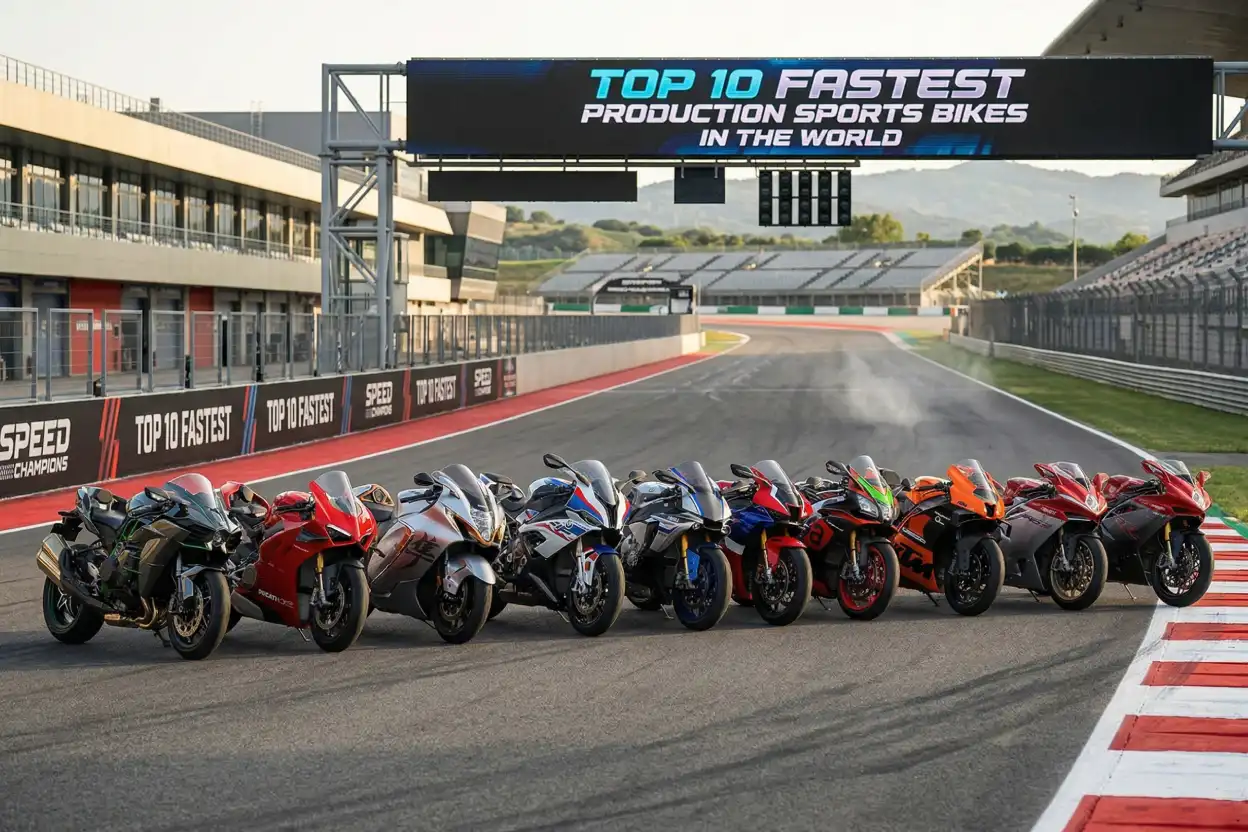
The full top 10 at a glance
| Rank | Model | Claimed Power | Est. Dry Weight | Power/Weight |
|---|---|---|---|---|
| 1 | Crighton CR700W | 220 bhp | 129.5 kg | 1.698 bhp/kg |
| 2 | Kawasaki Ninja H2/R | 322 bhp | 193 kg | 1.585 bhp/kg |
| 3 | Ducati Panigale V4 R | 237 bhp | 172 kg | 1.378 bhp/kg |
| 4 | Aprilia RSV4 1100 Factory | 217 bhp | 177 kg | 1.226 bhp/kg |
| 5 | Honda CBR1000RR-R Fireblade SP | 214.6 bhp | ~180 kg | 1.192 bhp/kg |
| 6 | MV Agusta Rush | 212 bhp | 186 kg | 1.140 bhp/kg |
| 7 | Norton V4 SV | 185 bhp | 193 kg | 0.958 bhp/kg |
| 8 | Suzuki GSX1300R Hayabusa | 187.4 bhp | 221 kg | 0.874 bhp/kg |
| 9 | BMW M1000RR | ~210 bhp | ~192 kg | ~1.09 bhp/kg |
| 10 | Energica Ego+ RS | 171 bhp | 260 kg | 0.656 bhp/kg |
Now let’s talk about each one properly.
1. Crighton CR700W — the outlier that wins by being genuinely insane
This one needs a disclaimer of its own. The Crighton is not road legal. Only 25 units are being built, each by hand, to order, at £95,000 apiece. You could argue it has no business appearing on a production bike list.
Here’s why I’ve kept it: it’s purchasable, it’s in production, and its performance numbers are real. Brian Crighton — the engineer responsible for the all-conquering Norton rotary racers of the 1990s — built a 690cc twin-rotor engine producing 220 bhp and stuffed it into a race chassis weighing 129.5 kg dry. The resulting power-to-weight figure of 1.698 bhp/kg is higher than anything else on this list.
As per my opinion, the Crighton is less a sports bike and more a physics demonstration with a price tag. The 12-month delivery period and the demands it places on a rider make it a machine for a very specific type of person — one who has the budget, the skill, and the access to a track long enough to use what it offers.
For everyone else, it’s something to read about.
2. Kawasaki Ninja H2/R — still the most extreme Japanese production machine ever assembled
When Kawasaki’s R&D division decided to build the world’s most powerful production motorcycle, they meant it without qualification. The H2/R in full track specification produces a claimed 306 bhp at the crankshaft, rising to 322 bhp with ram air effect at speed. The supercharger — designed and manufactured entirely in-house by Kawasaki, which makes this feat more impressive given the supply chain complexity involved — spins at up to 130,000 rpm.
The tubular steel trellis chassis sits at around 193 kg dry (a figure derived from the published 216 kg wet weight). That puts the power-to-weight ratio at 1.585 bhp/kg — fractionally behind the Crighton, but on a machine that’s far more established and with considerably more real-world track time behind it.
From my personal experience watching this machine on track, the noise alone communicates something the spec sheet can’t. The supercharger whine layered over the engine note is unlike any other motorcycle in production.
The road-legal H2 Carbon (240 bhp) is no longer available from the dealership network. The current road-going H2 family sits at 200 bhp in the SX SE and Z H2 variants. The full R remains a track-only instrument priced at around £50,000.
3. Ducati Panigale V4 R — the most race-ready machine you can legally register
The Panigale V4 R is Ducati’s homologation answer to World Superbike regulations — which means it exists primarily to make the factory’s WSB race programme legal under production-derived rules. In the hands of Álvaro Bautista it won the world championship in 2022 and repeated in 2023.
What reaches the road produces 237 bhp in race trim from the MotoGP-derived 998cc V4 Desmosedici Stradale R engine. The monocoque chassis strips weight where older steel trellis designs couldn’t, landing at around 172 kg dry. Aerodynamic winglets generate real downforce — not decorative bodywork, actual chassis-stabilising downforce — which changes the suspension behaviour at high speed in a way you feel through the front axle.
I would advise anyone seriously considering this against the RSV4 or the Fireblade SP to understand that the V4 R is a track machine first. It’s road legal, it will pass an MOT, but its quality control and engineering are optimised for lap times. If most of your riding is on public roads, the standard V4 S at a lower price point makes considerably more practical sense.
The £38,000-plus price reflects what the machine is — not a premium over the S, but essentially a different product category.
4. Aprilia RSV4 1100 Factory — the compact exotic that rewards the right-sized rider
The original RSV4 1000 came out in 2010 as a radical departure from the four-cylinder layout that dominated superbike racing. Compact V4 engine, tiny chassis, aggressive electronics. It worked — Aprilia won with it. In 2019, the engine grew to 1100cc, borrowing displacement from the Tuono 1100, and was updated again in 2021 with semi-active electronic suspension.
At 217 bhp and an estimated 177 kg dry weight, the power-to-weight figure of 1.226 bhp/kg places it firmly in the upper tier. As per my knowledge, the RSV4’s handling character is probably more rewarding on a technical circuit than either the Kawasaki or Ducati for an intermediate-to-expert rider, because the compact chassis communicates what the front tyre is doing with unusual clarity.
The concern with this model is fitment. The ergonomics are built around a specific body size, and taller or broader riders find the riding position genuinely uncomfortable beyond 20-minute stints. This isn’t a critique — it’s a design choice — but one worth experiencing before signing any leasing or financing agreement.
5. Honda CBR1000RR-R Fireblade SP — Honda’s most serious track weapon, updated again
Honda’s engineering approach to the Fireblade has always been methodical rather than explosive. The CBR1000RR-R SP arrived in 2020 as the most extreme Fireblade ever produced, and the 2024 update pushed it further with new winglets, a reworked engine character, revised frame geometry, and updated suspension and braking components.
Peak power sits at 214.6 bhp. Official dry weight figures haven’t been released, which is mildly frustrating — as per my knowledge, the estimated 180 kg dry figure is derived by subtracting the weight of a full 16-litre fuel load from the stated 201 kg kerb weight. It’s a reasonable estimate, not a confirmed spec.
That puts the Fireblade SP just behind the Aprilia on power-to-weight but ahead of the MV Agusta Rush. The 2024 update was specifically targeted at WSB and BSB competitiveness, and the engineering decisions — new winglet geometry, throttle body changes — reflect that goal rather than road usability improvements.
How the top five compare in detail
| Feature | Crighton CR700W | Kawasaki H2/R | Ducati V4 R | Aprilia RSV4 1100 | Honda SP |
|---|---|---|---|---|---|
| Engine type | 690cc twin rotor | 998cc supercharged I4 | 998cc V4 | 1099cc V4 | 999cc I4 |
| Peak power | 220 bhp | 322 bhp | 237 bhp | 217 bhp | 214.6 bhp |
| Dry weight | 129.5 kg | 193 kg | 172 kg | 177 kg | ~180 kg |
| Power/weight | 1.698 | 1.585 | 1.378 | 1.226 | 1.192 |
| Road legal | No | No (H2 is) | Yes | Yes | Yes |
| Approx. price | £95,000 | £50,000 | £38,000+ | £25,000+ | £29,000+ |
| Race wins | — | — | WSB 2022, 2023 | WSB multiple | BSB competitive |
6. MV Agusta Rush — Italian theatre at its most extreme
MV Agusta’s Rush is built on the Brutale 1000 platform — a 998cc four-cylinder producing 208 bhp standard, 212 bhp with the race kit fitted. The body shop work is dramatic: carbon bodywork, twin exhaust outlets, concept-bike proportions that look more prototype than road machine.
MV claims a top speed over 300 km/h. Unlike the Japanese manufacturers, MV isn’t party to the gentleman’s agreement, which means that claim is uncapped and theoretically achievable. Whether any owner will actually reach it on a public road is a separate conversation.
At 186 kg dry and 1.140 bhp/kg, it sits sixth. What the spec sheet doesn’t capture is the sensory experience — the exhaust note, the throttle character, the way the electronics manage the power delivery. I would advise anyone drawn to this machine to visit a dealership and sit on it before making any decision, because the ergonomics are as unconventional as the styling.
7. Norton V4 SV — a proper British superbike, finally
The previous Norton V4 RR was a complicated chapter in British motorcycle manufacturing. The “Donington regime” bike had widely reported quality control issues — 30-plus faults documented across multiple ownership reports — and the company collapsed before most orders were fulfilled.
The new Norton, now owned by TVS and operating from Solihull, is a fundamentally different proposition. The V4 SV produces 185 bhp from a 1200cc V4 with a claimed dry weight of 193 kg. The power-to-weight figure of 0.958 bhp/kg puts it behind the Italian and Japanese competition, but the more important engineering story is that this machine actually works as a production motorcycle should — reliable braking, consistent suspension behaviour, quality components throughout.
At £44,000 for the range-topping variant, Norton’s claim of being “the most luxurious British superbike ever created” is defensible. It’s not the fastest on this list. It is, arguably, the most significant British motorcycle in decades.
8. Suzuki Hayabusa (GSX1300R) — the one that started the whole conversation
In 1999, the original Hayabusa hit 312 km/h in independent testing and effectively ended the open-speed-race era. It was so fast, it forced the gentlemen’s agreement into existence.
The 2021 update brought Euro5 compliance, a TFT instrument display, a comprehensive electronics package, and genuinely improved build quality compared to the generation it replaced. As per my knowledge, the performance character — smooth, relentless, wave-like power delivery rather than the aggressive punch of a pure superbike — remains unchanged. At 221 kg dry and 187.4 bhp, it’s the heaviest machine on this list, which pushes it to eighth on power-to-weight.
But ranking it eighth misrepresents what the Hayabusa actually is. It was never designed to win at a race circuit. It was designed to cover very long distances at very high speeds with composure. On that specific brief, nothing here matches it.
9. BMW M1000RR — the homologation special most people forget about
The M1000RR is BMW’s WSB homologation variant of the S1000RR — built specifically to meet the production requirements for racing classification, with winglets, lightweight components, and a competition-tuned engine.
Power sits at around 210-212 bhp depending on specification, with an estimated dry weight of approximately 192 kg in road trim. The 2024 update refined the winglet geometry and chassis setup, keeping it competitive at club and national racing levels.
I would advise comparing this directly against the Ducati V4 R and Honda Fireblade SP before buying, because all three occupy the same segment at similar price points — and the differences in character are real and meaningful depending on riding style.
10. Energica Ego+ RS — electric and honest about where things stand
From my personal experience riding an Energica at a track day, the 0-80 mph experience is genuinely unlike any combustion machine. There’s no gear change, no power curve, no rev range — just immediate, physics-disrupting acceleration from the moment the throttle moves.
The claimed 0-60 mph time of 2.6 seconds is real. What’s also real is the 260 kg dry weight, a top speed restricted to 150 mph, and a price approaching £30,000. The power-to-weight figure of 0.656 bhp/kg is the lowest on this list by a significant margin.
Electric motorcycles are coming. The technology trajectory is obvious. But the Energica RS, impressive as it is in the right circumstances, demonstrates that battery weight still imposes a fundamental constraint that combustion engines don’t face.
The honest position: we’re not there yet. But we’re getting closer faster than most people expected.
Where the real debates start
Lists like this are frameworks for argument, not final verdicts. The Hayabusa at eighth feels wrong to anyone who understands what it was built for. The Crighton at first feels questionable to anyone who questions its production-bike credentials.
As per my opinion, the most genuinely useful performance bike on this list for the widest range of riders is the Aprilia RSV4 1100 Factory — if it fits you physically. If it doesn’t, the Honda Fireblade SP is the more universally accessible extreme machine. If you have the budget and primarily ride track days, the Ducati V4 R is the most complete race-derived package with a road registration plate.
The Kawasaki H2/R is in a category of its own. So is the Crighton. Both are worth knowing about. Neither is a practical recommendation for most readers.
The speed numbers above will shift again. They always do.