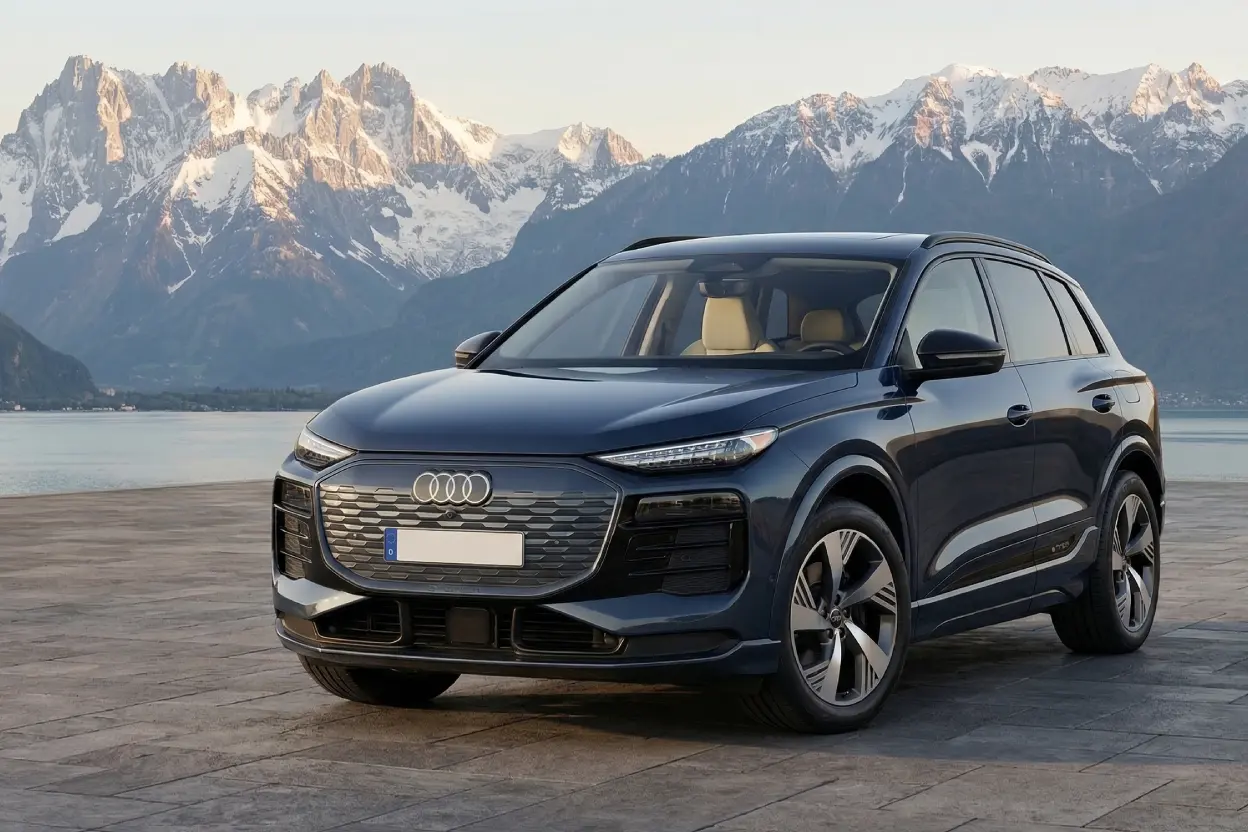
I spent a week with the 2025 Audi Q6 e-tron Quattro Prestige. Not a press event lap, not a 20-minute test drive in traffic. A full seven days of daily use — grocery runs, highway stints, charging anxiety, the works. The sticker on this particular unit read $76,790 as tested, starting from a base of $65,800. That’s serious money. So let me be direct about what this SUV gets right, what it doesn’t, and whether the premium is actually justified.
First look: does it even read as an EV?
Honestly, not immediately. Audi’s design language is so consistent across the lineup that the Q6 e-tron Quattro in profile looks like any other Q-series SUV that rolled off the assembly line in Ingolstadt. You’d need to look harder for the tells. No traditional grille up front — just a closed-off fascia. Black trim strips running along the doors carry the “e-tron Quattro” badge if you get close enough. The B-pillar is monogrammed too. And from behind, no exhaust outlets anywhere. That’s it. That’s the EV signaling Audi is doing.
As per my opinion, this is both a strength and a missed opportunity. Buyers who want the car to blend in with combustion-powered siblings will love it. People who paid $65,800-plus for a statement piece might feel slightly shortchanged on visual drama.
The chassis is shared with the Porsche Macan Electric — a fact worth knowing because it means the platform underneath is genuinely contemporary, not a carry-over adaptation.
Performance: quick, not shocking
The e-tron Quattro runs dual electric motors — one axle each — producing 456 horsepower and 631 lb-ft of torque combined. The battery is a 94.4-kWh unit running on an 800-volt architecture.
From a standing start, my personal experience clocked the 0-60 run at just under five seconds. The official figure is 4.4 seconds. Either way, it’s brisk. But here’s where I need to be honest — at this price point, in this segment, 456 horsepower is actually the weakest number at the table. The Cadillac Lyriq AWD puts out 500 horsepower. The Genesis Electrified GV70 does 483. Audi trails both.
That gap doesn’t make the Q6 slow. It makes the spec sheet less flattering when a buyer compares them side by side at a dealership, which they will.
Where the suspension and ride quality genuinely shine is on longer road trips. Audi’s R&D team clearly tuned the Q6’s suspension for comfort over handling sharpness. The result is an SUV that absorbs road surface irregularities quietly, stays composed on the highway, and doesn’t transmit much cabin noise at speed. If you push it through corners, it obliges — but it won’t encourage you to. That role belongs to the SQ6 e-tron Quattro, which runs 510 horsepower in Boost mode.
Regenerative braking and one-pedal driving
This is where the Q6 does something genuinely clever. The smart regeneration system reads data from a long-range radar, the front camera, road sign recognition, and the navigation system simultaneously to decide how much retardation to apply when you lift off the accelerator. In practice, it feels intuitive in a way that a lot of EVs don’t manage — it slows appropriately for junctions and traffic without being abrupt or unpredictable.
You can also configure it manually, setting a fixed level of regeneration that stays constant regardless of what the sensors read. And yes, it can bring the car to a complete stop without you touching the brake pedal. As per my knowledge, this level of adaptive one-pedal refinement is among the better implementations in the segment right now.
Range and charging: the honest numbers
The EPA rates the Q6 e-tron Quattro at 295 miles of range and 95 MPGe combined (102 city, 89 highway). Real-world? The best I saw on a full charge was 265 miles. That’s about a 10% shortfall from the EPA estimate — which is fairly typical across EVs but worth flagging if you’re planning longer routes without charging stops.
The 800-volt architecture earns its keep here. On a 350-kW CCS fast charger at an EVgo station, the Q6 went from 10% to 90% in just over 35 minutes. That’s the kind of charging speed that makes a difference on a road trip. If you’re accustomed to 400-volt EVs sitting at a charging station for 45-plus minutes, this is a meaningfully better experience.
Interior: brilliant and slightly overwhelming
From a quality control standpoint, the cabin materials are excellent. Sustainable choices, premium textures, nothing that rattles or looks like it cut corners in the body shop. The driver’s seat adjusts in multiple directions and works well with the steering wheel’s range of movement — finding a comfortable driving position took about 30 seconds.
Rear seat passengers get adequate legroom and hip room. Not expansive, but comfortable for two adults on a longer drive. Visibility out of the car is clean in all directions.
Now, the tech. There is a lot of it.
The main display arcs gracefully from behind the steering wheel across to the center console. A second screen sits in front of the passenger seat — it can display streaming video, blocked from the driver’s view when the SUV is in motion. On top of that: augmented reality head-up display, traffic sign recognition, smart cruise control, lane keeping, parking assistance, animated headlight and taillight signatures, and adjustable daytime running lamp patterns.
My unit also had the optional 830-watt Bang & Olufsen stereo with 3D sound and speakers built into the front headrests. Add in automated emergency braking with pedestrian detection and a drowsiness monitor, and you have a technology package that is genuinely comprehensive.
I would advise first-time Audi buyers to spend some time with the interface before driving off the forecourt. Not because it’s unintuitive — it isn’t — but because the sheer volume of adjustable settings is significant. The good news is that after two days, most of it becomes second nature.
Storage and practicality
The cargo area behind the rear seats is generously sized, and the split-folding rear bench adds more when needed. Upfront, where a combustion engine would normally live, there’s a small frunk — not massive, but useful for cables and small bags. Door pockets, a center console bin, and a glovebox round out the storage situation. Nothing revolutionary, but nothing missing either.
How does the Q6 e-tron Quattro compare to its segment rivals?
This is the comparison that actually matters for anyone spending $65,000-plus on an electric SUV. Here’s the straight breakdown:
| Feature | Audi Q6 e-tron Quattro | Cadillac Lyriq AWD | Genesis Electrified GV70 |
|---|---|---|---|
| Base price | $65,800 | $64,495 | $64,830 |
| Horsepower | 456 HP | 500 HP | 483 HP |
| Torque | 631 lb-ft | 450 lb-ft | 516 lb-ft |
| EPA range | 295 miles | 314 miles | 236 miles |
| 0-60 mph | 4.4 sec | ~4.6 sec | 3.9 sec |
| Battery | 94.4 kWh | 102 kWh | 77.4 kWh |
| Charging architecture | 800V | 400V | 800V |
| Fast charge speed | 270 kW | 190 kW | 350 kW |
| Suspension tuning | Comfort-biased | Comfort-biased | Sport-biased |
| Frunk | Yes (small) | No | No |
The Lyriq wins on horsepower and range, and undercuts the Audi on price. The GV70 is the sportier driver’s choice but gives up significant range. The Q6 sits in the middle — not the most powerful, not the cheapest, but probably the most complete package when the 800-volt charging speed and interior quality are factored in.
Comparing to the older Q7 e-tron (Audi’s earlier hybrid attempt)
For context on how far Audi has come, it’s worth looking back at the Q7 e-tron Quattro — the plug-in hybrid variant from 2016-2019 that represented Audi’s earlier push into electrification.
| Feature | Q7 e-tron Quattro (2016-2019) | Q6 e-tron Quattro (2025) |
|---|---|---|
| Powertrain type | PHEV (3.0L TDI + electric motor) | Full BEV (dual electric motors) |
| Total output | 373 HP | 456 HP |
| Electric-only range | ~34 miles | 295 miles |
| Battery capacity | 17.3 kWh | 94.4 kWh |
| Transmission | 8-speed Tiptronic | Direct drive |
| Charging architecture | AC only (up to 7.2 kW) | 800V DC (up to 270 kW) |
| CO2 emissions | ~48 g/km (official PHEV figure) | 0 g/km |
The generational jump is significant. The Q7 e-tron was always a combustion car with electric assistance — the electric range was barely enough for a commute. The Q6 e-tron is a proper electric vehicle with infrastructure-grade fast charging. The R&D investment between those two generations shows.
What the sticker price is really buying you
At $76,790 as tested, this is not an impulse purchase. As per my knowledge, the strongest arguments for the Q6 over its Cadillac and Genesis rivals are the 800-volt charging architecture, the software refinement of the adaptive regeneration system, and the interior build quality. The Bang & Olufsen audio system also genuinely sounds excellent — not just good for a car.
The arguments against: less horsepower than both main rivals, a real-world range that falls noticeably short of the EPA rating, and an interface that takes some learning. Also worth noting — Audi is skipping the 2026 model year entirely. The Q6 returns for 2027. That’s an unusual supply chain decision that might affect resale considerations.
I would advise anyone seriously considering this against the Lyriq AWD or GV70 to test all three on a proper drive — not a short loop. The Q6’s ride quality advantage becomes apparent on longer stints, and that’s not something a spec sheet communicates. If your priority is power and value, the Cadillac is hard to argue with. If you want the sportiest drive, the Genesis GV70 is sharper. If you want the most polished, quietly capable all-rounder — the Q6 is probably it.