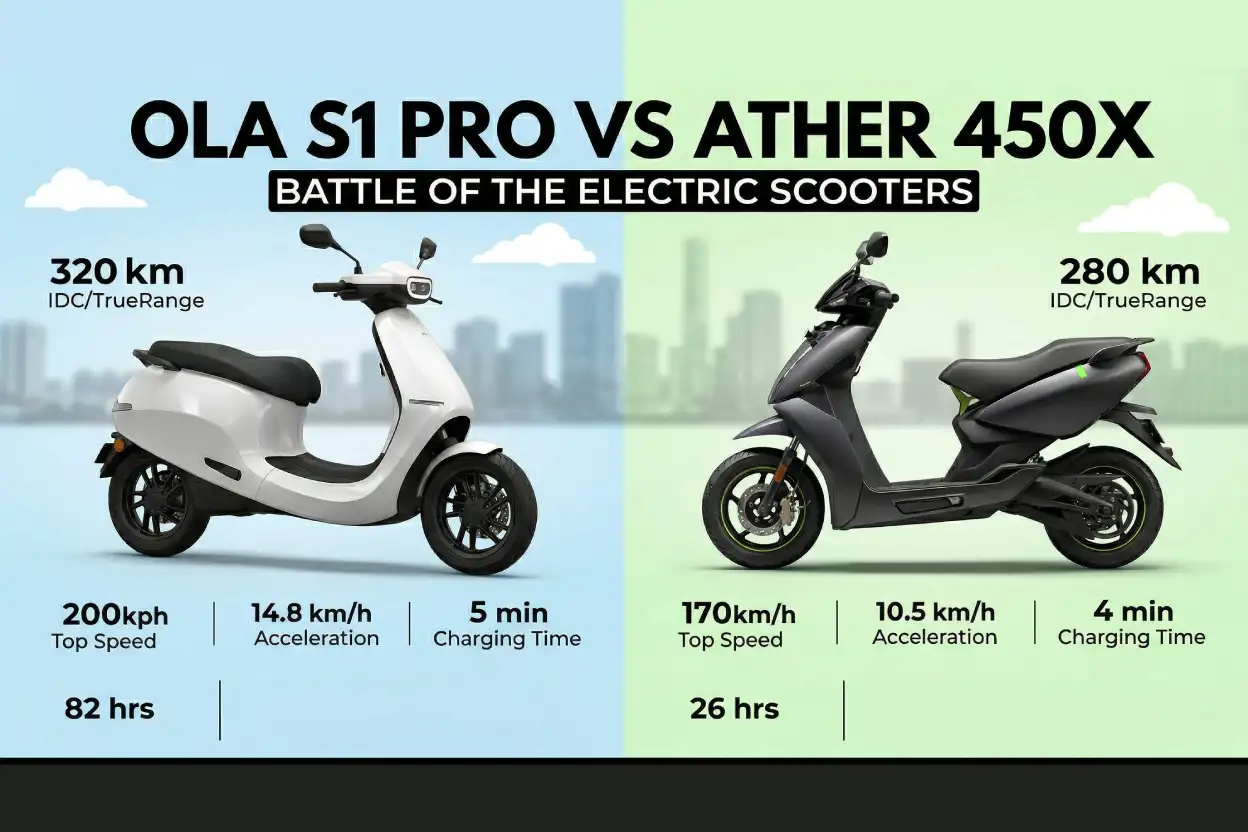
The Indian EV landscape has shifted dramatically. Electric scooters in 2026 are no longer novelties — they’re serious machines with real engineering behind them. Having spent months on both the Ola S1 Pro and the Ather 450X, I’ve seen how much has changed, including the chassis design, software stability, and general build confidence.
Choosing between these two isn’t just a spec comparison. It’s a question of what kind of ownership you want. Ola is chasing scale. Ather is chasing precision. They’ve made very different bets, and it shows in how the bikes actually feel.
How Far Have We Come?
In 2021–22, both brands were still figuring things out. Range hovered around 80–110 km, home charging was the only real option, and build quality was… generous. Here’s how things look now:
| Feature | 2022 (Gen 1/2) | 2026 (Gen 4/5) |
| Average Range | 80–110 km | 150–195 km |
| Charging | Standard home only | Fast-charging + V2L |
| Build Materials | Heavy use of plastics | Lightweight alloys and composites |
| Service | Patchy | Nationwide dealer networks |
1. Performance: Raw Power vs. Refined Feel
The Ola S1 Pro wins the spec sheet. A 4 kWh battery, 13.5 kW peak motor output, top speed of 120 kmph — on a closed track, the torque delivery is almost jarring, in a fun way.
But raw numbers aren’t everything. The Ather 450X runs a slightly smaller 3.7 kWh pack, but Ather’s thermal management on those cells is noticeably better. The 0–40 kmph pull feels more predictable, more willing — like the bike knows what you want before you ask for it. If you spend most of your time threading through city traffic, the Ather is the more satisfying tool.
2. Ride, Suspension, Braking
This is where the philosophies really diverge.
The Ola now has a proper front suspension — a real improvement over the single-fork design that attracted so much criticism in earlier generations. It’s soft and forgiving. Potholes near a construction site? The Ola absorbs them without complaint.
The Ather frame is machined aluminum. It’s stiffer, more communicative. Under hard braking at speed, there’s a stability and feedback through the bars that the Ola doesn’t quite match.
3. Software and Features
Ola’s interface is ambitious. Cruise control, hill hold, Party Mode — it’s a feature list that impresses people at dinner parties. The problem is that more features means more things that can go wrong. I’ve experienced enough lag and occasional crashes to lower my trust in it.
Ather’s software is more restrained. It rarely freezes. And their “TrueRange” estimate is actually accurate — when it says 42 km, there’s 42 km left. Ola’s range estimates are… optimistic. Sometimes aggressively so.
4. Ownership, Service, Financing
Ola’s scale means competitive financing and leasing options. Their service experience has been inconsistent — better than it used to be, but still the most common complaint you’ll hear from owners.
Ather’s service centers are more predictable. If you want to feel good about handing your bike over to someone, Ather gives you more reason to.
2026 Comparison: The Main Contenders
| Model | Battery | Top Speed | Real-World Range | Underseat Storage |
| Ola S1 Pro | 4.0 kWh | 120 kmph | ~170 km | 34 L |
| Ather 450X | 3.7 kWh | 90 kmph | ~110 km | 22 L |
| TVS iQube ST | 5.1 kWh | 82 kmph | ~150 km | 32 L |
| Bajaj Chetak | 3.2 kWh | 73 kmph | ~110 km | 21 L |
Final Verdict
Get the Ola S1 Pro if you want the longest range, the most storage, and you enjoy showing off features. It’s the better machine on paper.
Get the Ather 450X if you want something that works consistently, tells you the truth about range, and feels like it was engineered rather than assembled by deadline.
After months of going back and forth, I grab the Ather when I actually need to get somewhere. I take the Ola out when I’m not in a hurry and want to enjoy the ride.