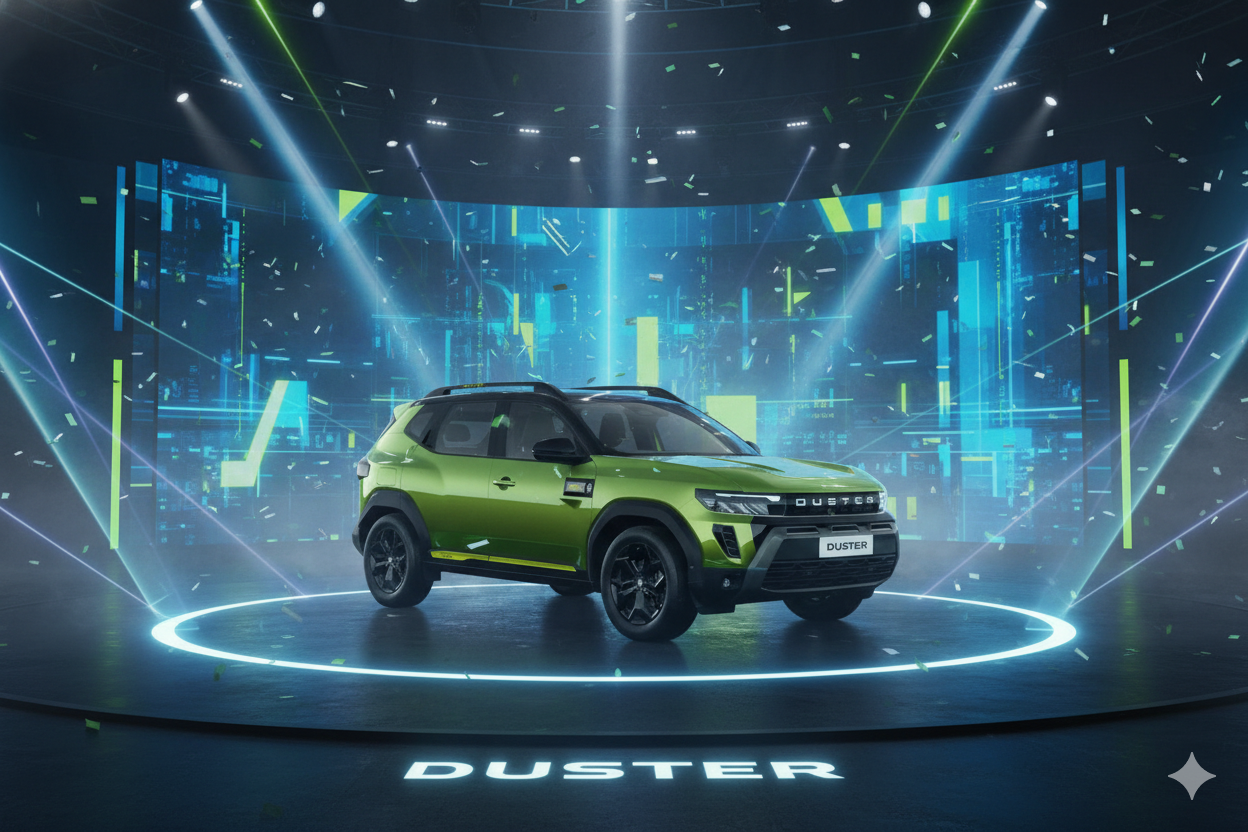
The wait is finally over. On January 26, 2026, Renault officially pulled the silk off the 2026 Duster in India, marking a triumphant return for the marque that arguably birthed the compact SUV craze in our country. I still remember the original Duster—it was rugged, unpretentious, and had a suspension setup that could glide over craters. This new model, however, is a different beast entirely. It’s no longer just a “utilitarian” choice; it has evolved into a high-tech powerhouse aimed at the throat of the Hyundai Creta and Tata Sierra.
While official price tags are slated for a mid-March reveal, as per my knowledge, we are looking at a competitive bracket between Rs 12 lakh and Rs 25 lakh (on-road Mumbai). If you’re itching to get back into the Duster family, pre-bookings are open via the R-Pass for a token of Rs 21,000. But before you swipe that card, let’s dissect whether this automaker has truly delivered a “calculated tactical maneuver” or just a fancy facelift.
🎨 Design: Rugged Sophistication Meets the “Body Shop”
The 2026 Duster’s silhouette remains unmistakably “Duster,” but the details are razor-sharp. The front fascia is dominated by eyebrow-shaped LED DRLs that pull double duty as indicators. I particularly like the heavily sculpted front bumper and the silver skid plate—it gives the car a muscular stance that many soft-roaders in this segment lack.
With a massive 212mm ground clearance, it’s clear the R&D team hasn’t forgotten the car’s off-pavement roots. The side profile features beefy black cladding and C-pillar mounted rear door handles, a quirky touch that differentiates it from the sea of generic SUVs. At the rear, the V-shaped connected LED tail lamps and a distinctive spoiler provide a modern signature. The “Stealth Black” and “Jade Mountain Green” are, in my personal experience, the standout shades from the six-color palette.
🛋️ Cabin & Tech: Practicality Over Gimmicks
Stepping inside the body shop finished interior, it’s clear Renault has prioritized ergonomics. Instead of the trendy but distracting triple-screen setups, they’ve stuck to a floating 10.1-inch infotainment display and a 10.25-inch digital cluster.
As per my opinion, the inclusion of physical buttons for climate control is a masterstroke. In an era where you have to dig through three menus just to change the fan speed, the Duster’s tactile layout is a breath of fresh air. The faux carbon finish on the dashboard adds a premium touch, though I am slightly concerned about how these surfaces will hold up under the harsh Indian sun over long-term use.
Key Feature Highlights:
-
700-Litre Boot Space: This is absolutely cavernous. You could practically move house with this much room.
-
Panoramic Sunroof: A non-negotiable for Indian buyers in 2026.
-
Level-2 ADAS: Includes adaptive cruise control, lane assist, and emergency braking.
-
Creature Comforts: Dual-zone climate control, 360-degree camera, and 6-way ventilated electric seats.
🆚 Evolution of a Legend: Old Duster vs. 2026 Duster
To appreciate how far we’ve come, we have to look back at the prototype that started it all. The original was simple; the new one is a technological marvel.
| Feature Area | Original Renault Duster (2012-2022) | 2026 Renault Duster |
| Engine | 1.5L K9K Diesel / 1.5L Petrol | 1.3L Turbo TCe (160 BHP) / 1.8L Hybrid |
| Safety | Basic (2-4 Airbags, No ADAS) | 5-Star Rated, 6 Airbags, Level-2 ADAS |
| Transmission | Manual / AMT / CVT | 6-Speed DCT / 8-Speed DHT (Hybrid) |
| Interiors | Functional/Plastic-heavy | Premium, Faux Carbon, Digital Cockpit |
| Ground Clearance | 205mm – 210mm | 212mm |
| Boot Space | 475 Litres | 700 Litres |
⚙️ Performance: The 163 PS Powerhouse
Renault is offering a trifecta of engine choices to cover all bases. At the peak sits the Turbo TCe 160. This 1.3-litre GDi petrol motor churns out a segment-leading 160bhp and 280Nm of torque, paired with a lightning-fast 6-speed DCT.
However, the real “game changer” is the 1.8-litre dedicated hybrid. Paired with a 1.4kWh battery and an 8-speed DHT gearbox, it also produces over 160bhp but focuses on urban efficiency. I would advise city dwellers to wait for this variant, though deliveries won’t start until Diwali. The base 1.0-litre turbo-petrol will likely be the volume driver for those looking for a balanced supply chain between cost and performance.
🆚 Segment Rivalry: Can it Dethrone the Creta?
The compact SUV segment is currently a shark tank. Here is how the Duster stacks up against its fiercest competitors:
| SUV Model | Max Power (BHP) | Key Advantage | Boot Space |
| 2026 Renault Duster | 163 PS | Hybrid Tech & Huge 700L Boot | 700 L |
| Hyundai Creta | 158 BHP | Refinement & Massive Features | 433 L |
| Tata Sierra | 160 BHP | Iconic Design & Safety | 622 L |
| Kia Seltos | 158 BHP | Tech-Heavy Interiors | 433 L |
The Duster’s 700-litre boot and the 1.8L Hybrid option are unique selling points that neither the Creta nor the Seltos can currently match. If Renault manages the quality control (SPC) on the initial assembly line batches, they might just have a winner on their hands.