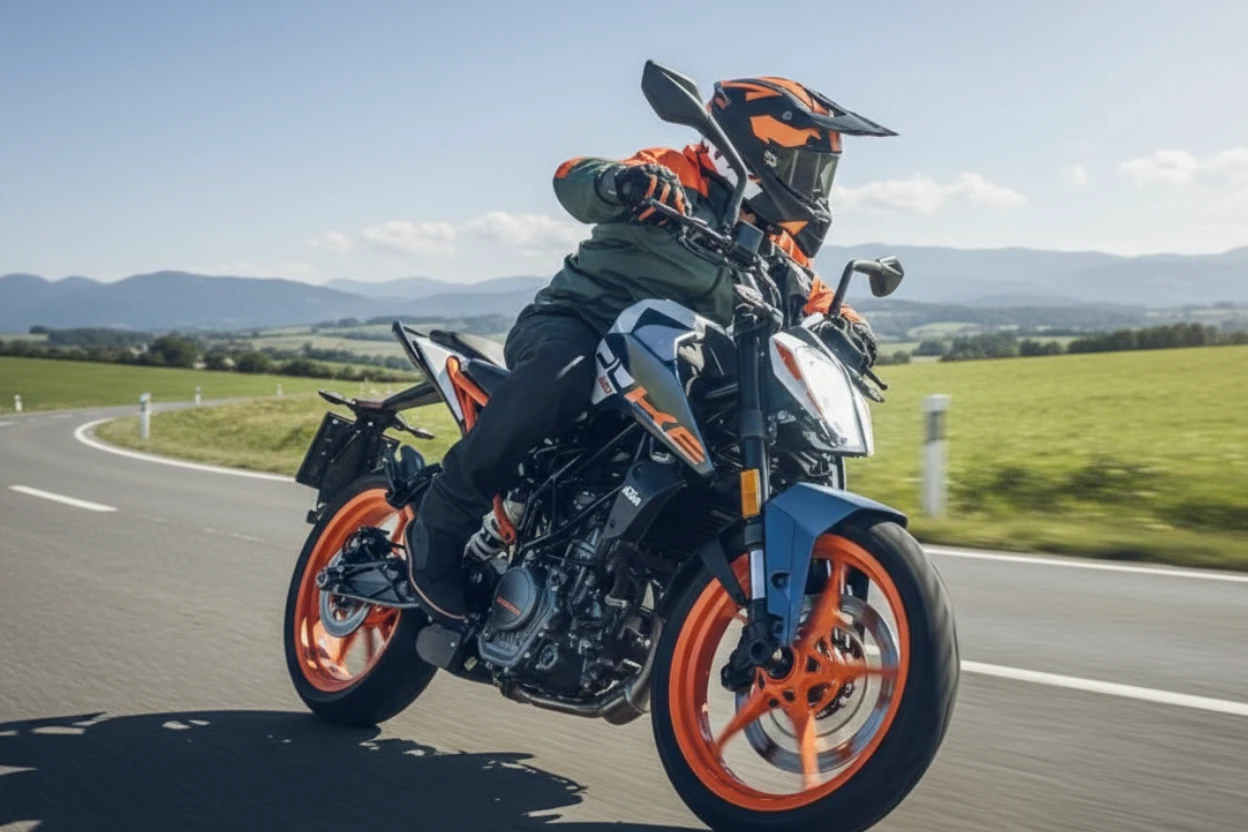
For years, the “Orange Brigade” has been synonymous with the thumping, high-strung character of the single-cylinder engine. From my personal experience riding every iteration of the Duke from the OG 373cc to the latest 399cc LC4c, there is an undeniable visceral charm to that “ready to race” vibration. However, the wind is shifting. News that KTM is partnering with Bajaj Auto to develop an all-new twin-cylinder platform in India for a 2028 debut isn’t just a product update; it’s a calculated tactical maneuver to salvage their dominance in the sub-500cc segment.
As per my knowledge, this move is a direct response to the “refinement wars.” While KTM was busy perfecting the world’s most powerful singles, rivals like Aprilia and Yamaha were winning over enthusiasts with the smooth, linear power delivery of parallel twins. This new Indian-made twin-cylinder engine, likely destined for a new generation of Duke, RC, and Adventure models, marks a massive departure for the Chakan assembly line.
The Evolution: From Single-Cylinder Thump to Twin-Cylinder Hum
To understand where we are going, we have to look at the chassis and heart of what came before. KTM’s journey in India has been defined by pushing the limits of what a single-cylinder (mono-cylinder) engine can do.
| Feature | The “Old” Guard (373cc/399cc) | The “New” Vision (Sub-500cc Twin) |
| Engine Configuration | Single-Cylinder, Liquid-Cooled | Parallel-Twin, Liquid-Cooled |
| Character | Aggressive, “Punchy,” High Vibration | Refined, Broad Powerband, Smooth NVH |
| Complexity | Simpler Maintenance, Lighter Weight | Dual Throttle Bodies, Complex Exhaust, Heavier |
| Target Power | ~43-45 BHP | ~47 BHP (A2 License Cap) |
| Manufacturing | High-Volume, Cost-Optimized | Precision Assembly, New R&D Tooling |
In my opinion, the transition from the 373cc unit (which arguably put KTM on the map in India) to the 399cc motor was a stop-gap. The 399cc was a masterpiece of quality control (SPC), but it still suffered from the inherent physics of a large single piston oscillating at high RPM. I would advise purists to temper their expectations; while the new twin will be faster and smoother, it might lose that “manic” personality that made the 390 Duke a cult classic.
Why India? Why Now?
The decision to house the R&D and manufacturing of this engine entirely within Bajaj’s Chakan facility is a testament to India’s maturing supply chain. We aren’t just a “body shop” for Europe anymore. This is a full-scale engine development project involving complex transmission systems and advanced catalytic converter integration to meet stringent Euro 5+ and upcoming Euro 6 norms.
However, I am slightly concerned about the weight penalty. A twin-cylinder engine requires a wider frame, two of almost everything (pistons, valves, spark plugs), and a more robust cooling system. KTM has always been the undisputed leader in power-to-weight ratios. If this new “490” or “500” twin balloons in weight, will it still feel like a KTM? Or will it become a “diet” version of the 790/890 series?
The Competitive Landscape: A High-Stakes Comparison
KTM is entering a crowded “Middleweight” colosseum. Gone are the days when the Duke 390 reigned supreme by default. Today, the automaker faces stiff competition from Japan and Europe, all of whom have realized that 45-50 BHP is the “sweet spot” for global markets.
| Metric | KTM 500 Twin (Projected) | Aprilia RS 457 | Kawasaki Ninja 500 |
| Engine | Parallel-Twin | Parallel-Twin (270° Crank) | Parallel-Twin |
| Max Power | ~47 BHP | 47.6 BHP | 45 BHP |
| Tech/Electronics | Ride-by-wire, IMU, TC | Lean-sensitive ABS/TC | Basic/Standard |
| Origin | Made in India (Bajaj) | Made in India (Piaggio) | Made in Thailand/Japan |
| Price Bracket | Premium/Aggressive | Premium | High (CBU/CKD taxes) |
As per my opinion, the Aprilia RS 457 has already set the benchmark for what a sub-500cc twin made in India can do. It sounds like a mini-V4 and handles like a dream. For KTM to reclaim its “assertive attempt” at the crown, the new 500cc platform must not only match the Aprilia’s specs but undercut it on the financing and leasing side through Bajaj’s massive dealership network.
Critical Analysis: The Risks of Scaled Production
While the prospect of an affordable KTM twin is exciting, there are hurdles. Developing an engine from scratch is an R&D nightmare. We saw the “RC 490” rumors circulate for years before being scrapped—likely because the manufacturing costs didn’t align with the target sales price.
-
Thermal Management: Two cylinders in a compact chassis generate significant heat. In Indian stop-and-go traffic, the cooling system (radiator and fan assembly) will be under immense stress.
-
Price Creep: Moving from a single to a twin isn’t just a small step; it’s a leap in component costs. If the price nears the 4.5 – 5 Lakh (INR) mark, it enters the territory of larger displacement bikes.
-
The “Single” Legacy: KTM plans to keep the 399cc single as a lower-tier offering. My concern is that this might dilute the brand. Will we see a “Duke 390” and a “Duke 480” sitting side-by-side in the showroom? That sounds like a marketing identity crisis in the making.
Predictive Outlook: What to Expect in 2028
Looking toward the EICMA 2027 reveal, I predict KTM will lean heavily into the “Adventure” side of this platform. A twin-cylinder 390 (or 490) Adventure is the bike the world has been screaming for. The highway cruising ability—the one major weakness of the current singles—will finally be addressed. Acceleration will be more linear, and the “buzzy” handlebars at 120 km/h will likely be a thing of the past.
I would advise potential buyers who are currently looking at the 2024 Duke 399cc to go ahead and pull the trigger now. 2028 is a long way off, and the first batch of any new engine platform often serves as a “real-world prototype” for quality control (SPC) refinements.
The move to a twin-cylinder setup is a necessary evolution. It shows that KTM and Bajaj are no longer content with being the best “small bike” makers; they want to dominate the mid-tier global market. It’s an ambitious, slightly risky, but ultimately inevitable shift in the automotive landscape.