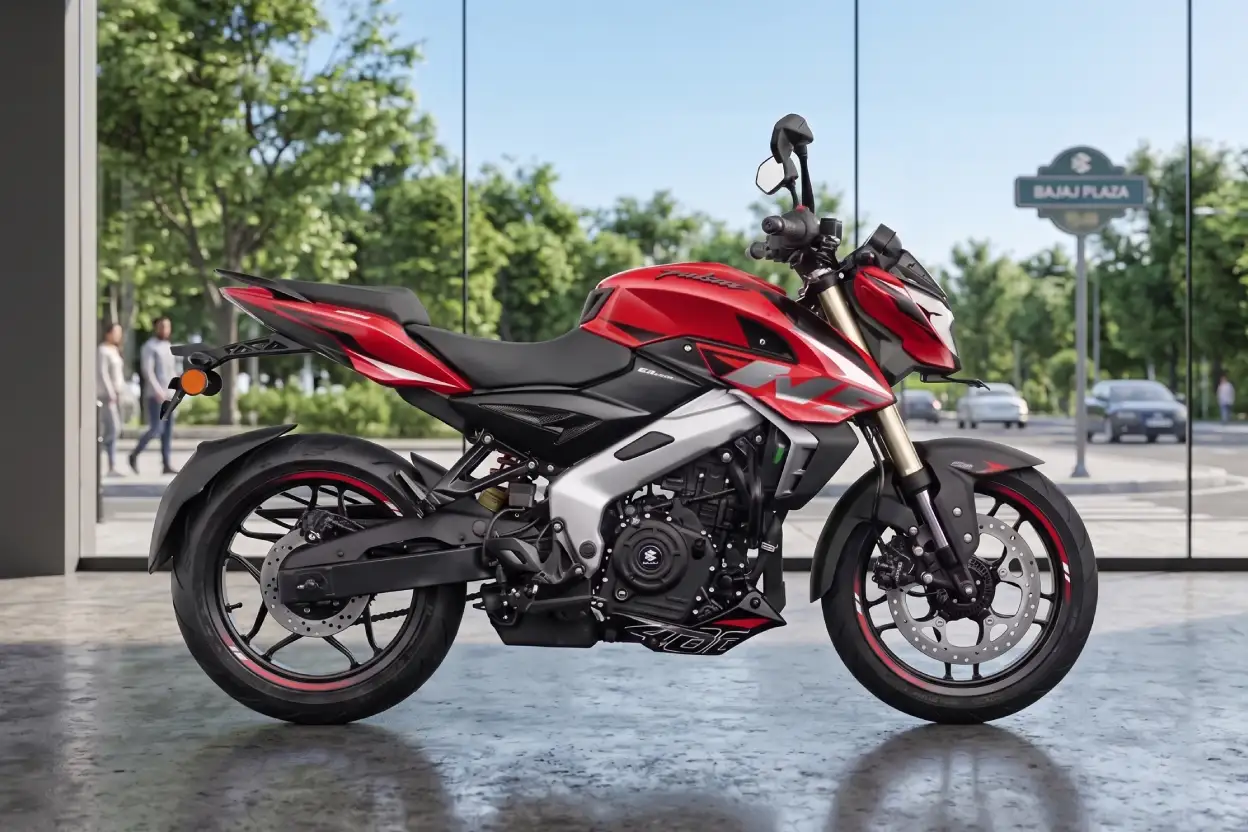
Bajaj just quietly swapped the engine in one of its best-selling nakeds. The numbers went down. The price didn’t. Here’s what’s actually going on.
What Actually Changed Under That Tank
Bajaj replaced the Pulsar NS 400Z’s 373 cc engine with a 349.13 cc unit. Liquid-cooled, single-cylinder, same basic architecture. On paper it reads like a downgrade. Most buyers won’t notice until they see the registration paperwork — and then they’ll probably be relieved.
The new engine makes 40.6 PS and 33.2 Nm of torque. That’s 2.4 PS and 1.8 Nm less than the 373 cc version, which was already quick enough to embarrass most things in this segment. The Chakan facility doesn’t rush revisions, so this wasn’t a panicked job — but the performance loss is real and I’d rather say that plainly than dress it up.
What’s more interesting is where the power arrives. Peak power at 9,000 rpm, peak torque at 7,500 rpm — both higher up the rev range than before. This is now a motor that needs to be worked: more revs, more gear changes, more involvement. On a weekend run through the ghats, that’s genuinely fun. Grinding through morning traffic in Bengaluru, you’re barely touching the powerband.
The Engineering Behind the Displacement Drop
To shrink from 373 cc to 349 cc, Bajaj shortened the piston stroke from 60 mm to 56.1 mm and left the 89 mm bore alone. It’s a standard approach — retuning stroke lets you hit a new displacement target without rebuilding the engine block, recasting cylinder heads, or reworking fuel delivery from scratch. Rebuilding the whole engine would have cost more in R&D, and those costs would have ended up in the ex-showroom price. This approach kept the supply chain intact and the assembly line running.
The GST Angle — This Is Really About the Tax Bracket
Here’s the part that explains the whole exercise. India taxes motorcycles below 350 cc at 18% GST. Above that threshold, the rate goes higher. The old NS 400Z, at 373 cc, was in the expensive bracket. The new 349.13 cc engine isn’t.
Bajaj already absorbed the GST 2.0 hike from earlier this year rather than passing it on, so the ex-showroom price stays at Rs. 1.93 lakh despite the revision. KTM has done something similar on Indian-spec prototypes. Triumph’s Speed 400 and Scrambler 400 X both benefit from the same sub-350 cc classification. Bajaj has been through this with the Dominar 400 — they know the math here.
| Motorcycle | Engine | Power | Torque | Price (ex-sh.) | ABS | Riding Modes |
| Bajaj Pulsar NS 400Z | 349 cc, liquid-cooled | 40.6 PS | 33.2 Nm | ₹1.93 L | Dual-ch. | 4 modes |
| KTM 390 Duke | 399 cc, liquid-cooled | 46 PS | 39 Nm | ₹3.11 L | Dual-ch. | 3 modes |
| Triumph Speed 400 | 398 cc, liquid-cooled | 40 PS | 37.5 Nm | ₹2.33 L | Dual-ch. | 2 modes |
| Royal Enfield Guerrilla 450 | 452 cc, liquid-cooled | 40.1 PS | 40 Nm | ₹2.39 L | Dual-ch. | 3 modes |
| Honda CB300R | 293 cc, liquid-cooled | 30.9 PS | 27.4 Nm | ₹2.72 L | Dual-ch. | None |
| Yamaha MT-03 | 321 cc, liquid-cooled | 42 PS | 29.6 Nm | ₹4.65 L | Dual-ch. | None |
Power-per-rupee index (PS per ₹1 lakh)
| Motorcycle | Index Value (PS/₹1 Lakh) |
| Bajaj Pulsar NS 400Z | 21.1 |
| Triumph Speed 400 | 17.2 |
| RE Guerrilla 450 | 16.8 |
| KTM 390 Duke | 14.8 |
| Honda CB300R | 11.4 |
| Yamaha MT-03 | 9.0 |
NS 400Z vs. its older siblings — how the platform evolved
| Model | Year | Displacement | Power | Cooling | Fuel System |
| Pulsar NS 160 | 2017 | 160 cc | 15.5 PS | Air/oil | FI |
| Pulsar NS 200 | 2012 | 199 cc | 23.5 PS | Air/oil | FI |
| Pulsar NS 400Z (373cc) | 2024 | 373 cc | 43 PS | Liquid | FI + RBW |
Pulsar NS 400Z (349cc)current |
2025–26 | 349 cc | 40.6 PS | Liquid | FI + RBW |
What Stays the Same
Everything structural carries forward. Perimeter frame, upside-down front forks, rear monoshock, 320 mm front disc, 230 mm rear, dual-channel ABS. The 17-inch alloys stay. The underbelly exhaust stays (it splits opinion, but it does keep heat off your legs).
Dimensions are unchanged: roughly 2,017 mm long, 804 mm wide, 1,075 mm tall, 1,344 mm wheelbase. The 12-litre tank is functional but not roomy — riding from Pune toward Mahabaleshwar on its predecessor, I was at a pump every 350–400 km. Not a dealbreaker, just something to factor in on longer runs.
Features Held Up Fine
Ride-by-wire, four riding modes (Road, Rain, Sport, Off-road), traction control, Bluetooth-connected digital console. The rain mode is worth mentioning because it actually works — it intervenes before the rear steps out rather than just existing as a label in the settings menu. LED projector headlamps, DRLs, sculpted tank, split seat, four colour options. All unchanged.
How Far This Platform Has Come
The NS 200 from the mid-2010s made 23.5 PS from 199 cc. Air-cooled, carburetted. The 400Z now makes 40.6 PS from 349 cc — nearly double the output from 75% more displacement. USD forks, liquid cooling, ride-by-wire, multi-mode traction control: none of that would have seemed realistic on a Pulsar a decade ago. The nameplate has been stretched a long way.
Against the Competition
The KTM 390 Duke beats it on power and torque, but costs nearly 60% more. The Triumph Speed 400 is a real fight on performance but can’t match the feature count at this price. The Honda CB300R costs more and makes less — hard to justify once a buyer starts comparing spec sheets.
Where It Works and Where It Doesn’t
My one genuine reservation is the rev band. If most of your riding is between 3,000 and 5,000 rpm — commuting, urban traffic, running errands — you’re spending most of your time below where this engine gets interesting. The old 373 cc unit hit peak torque lower in the range and was more accessible day-to-day. This one rewards people who actually use the gears.
That’s not a flaw, it’s just a riding style question. Test ride it in Sport mode before deciding. Ten minutes will tell you more than any spec comparison.