The luxury crossover segment was entirely conceptual before 1998. Back then, the Japanese marque took a calculated risk, blending the plush ride of a premium sedan with the elevated driving position and utility of an SUV. As per my knowledge, that early model—the RX 300—was an absolute revelation. It shifted the industry paradigm by ditching the heavy, truck-like chassis in favor of a unibody platform.
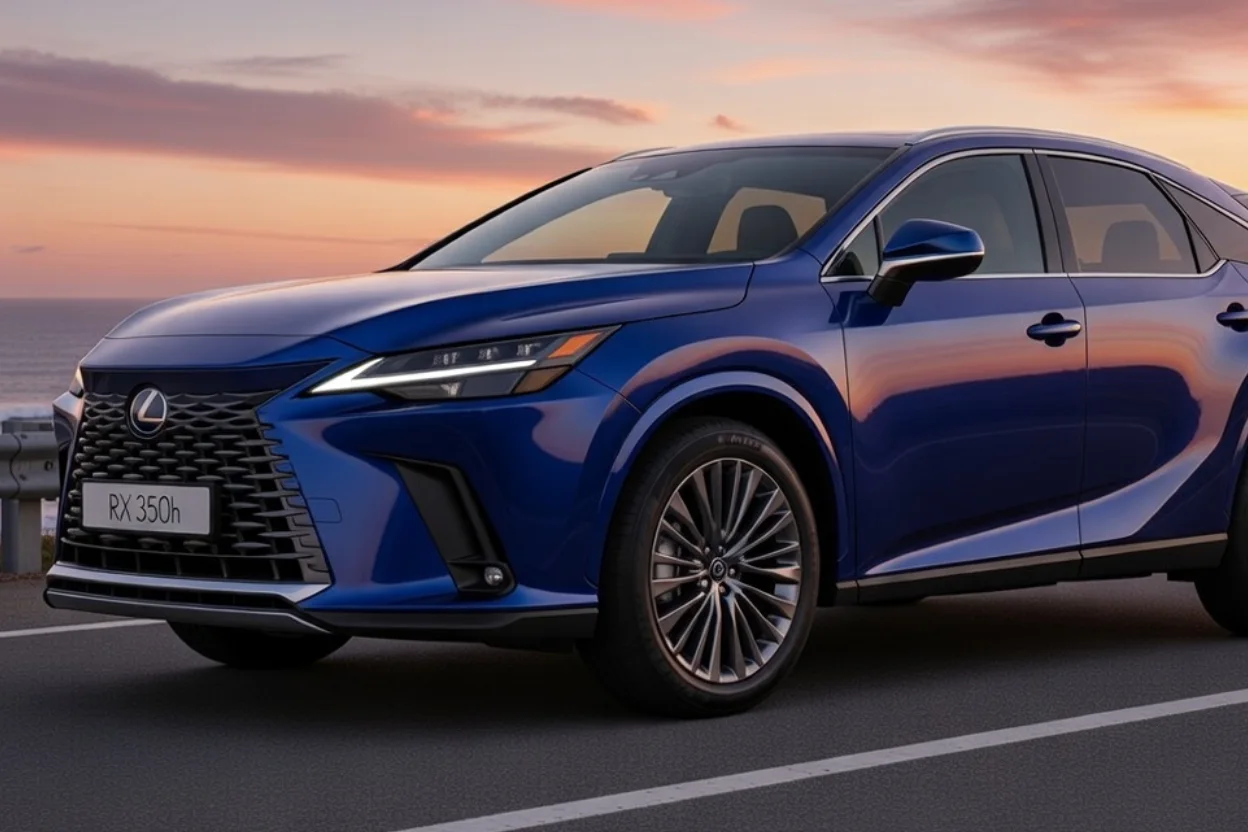
If we look back at those late-90s pioneers, automotive manufacturing was quite different. Engineers were just beginning to phase out older air-fuel mixture systems; while the original RX utilized fuel injection, much of the broader market was still weaning itself off the carburetor. Today, traversing from the initial prototype to the modern assembly line requires an incredibly complex supply chain and billions in R&D. The result of that evolution sits before us: the 2025 Lexus RX350h F Sport Design AWD.
Generational Shift: The Old Guard vs. The 2025 Iteration
To truly appreciate the current RX, we must compare it to its ancestors.
-
The Original (Late 90s/Early 2000s): Powered by a thirsty 3.0-liter V6 and a 4-speed automatic, the original RX prioritized velvet-smooth cruising. It was compact by today’s standards, featured basic analog instrumentation, and had a soft, almost floaty ride.
-
The 2025 RX350h: The current generation relies on a highly efficient 2.5-liter hybrid four-cylinder, replacing the V6 thirst with electrification. The ride remains exceptionally plush but boasts far superior structural rigidity. Analog dials have been usurped by a massive 14-inch touchscreen, and the suite of automated driver aids makes the original look entirely analog.
Design and Exterior Aesthetics
Lexus utilizes a design language known as L-finesse, which seeks to merge Japanese aesthetic hospitality with cutting-edge tech. The execution is undeniably striking. The spindle grille remains a bold focal point, while the tight panel tolerances achieved by the automaker‘s body shop showcase rigorous quality control (SPC).
Our reviewed unit, the F Sport Design (base price $55,705; tested at $60,230), outfits the crossover with aggressive, sporty fascias and unique 21-inch alloy wheels. However, buyers should interpret the badge carefully. The word “Design” is simply marketing speak; this is an appearance package. It does not alter the vehicle’s underlying dynamics. Still, its aggressive stance guarantees it will turn heads at the local car wash.
Under the Hood: Competent, But Leisurely
Let’s examine the mechanical components. The RX350h pairs an Atkinson-cycle inline-four engine with a continuously variable transmission (CVT) and two electric motors (one on each axle to provide all-wheel drive). Total system output is a modest 246 horsepower and 233 lb-ft of torque.
Based on my personal experience evaluating the performance data of this heavy 4,420-pound crossover, acceleration is merely adequate. It takes roughly seven seconds to reach 60 mph. As per my opinion, there are moments when the powertrain feels slightly overmatched. Overtaking on the highway requires premeditation; you must leave space, build momentum, and execute your pass deliberately to minimize time in the oncoming lane.
However, where it lacks in brute force, it excels in serenity. The suspension absorbs tarmac imperfections with zero drama. The braking is incredibly linear, seamlessly blending regenerative and friction stopping power without stressing the catalytic converter or burning unnecessary fuel. Speaking of fuel, this heavy crossover achieves an EPA-estimated 36 mpg combined, which means your visits to the gas station will be pleasantly infrequent.
The Cabin: A Masterclass in Isolation
Inside, the RX350h remains a two-row, five-seat sanctuary. (The three-row RXL has been retired, its place taken by the new TX).
The F Sport Design package elevates the environment with heated and ventilated front seats, open-pore wood trim, a power moonroof, and a heated steering wheel. It is remarkably quiet, isolating occupants from wind and road noise. Standard safety features—including automated emergency braking, lane-keeping assist, and adaptive cruise control—operate intuitively. Furthermore, practical utility hasn’t been sacrificed; dropping the second row expands cargo capacity from 29.6 cubic feet to a cavernous 46.2 cubic feet.
The Competitive Landscape
How does the reigning champion stack up against its fierce European rivals?
| Feature / Specification | 2025 Lexus RX350h F Sport Design | 2025 BMW X3 30 xDrive | 2025 Volvo XC60 Hybrid Core T8 AWD |
| Starting Price (Est.) | $55,705 | $51,125 | $59,345 |
| Powertrain | 2.5L I4 Hybrid | 2.0L Turbo I4 Mild Hybrid | 2.0L Turbo I4 Plug-in Hybrid |
| Combined Output | 246 HP / 233 lb-ft | 255 HP / 295 lb-ft | 455 HP / 523 lb-ft |
| 0-60 MPH Acceleration | ~7.0 Seconds | 6.2 Seconds | 4.5 Seconds |
| Combined Fuel Econ. | 36 MPG | 29 MPG | 28 MPG (36 miles EV range) |
| Driving Persona | Supreme Comfort / Efficient | Athletic / Balanced | Understated / Blisteringly Fast |
If you are currently cross-shopping these vehicles, I would advise looking closely at your daily driving habits. The Volvo XC60 T8 is an absolute powerhouse, offering sports-car acceleration with plug-in hybrid versatility. The redesigned BMW X3 bridges the gap with engaging driving dynamics.
Yet, the Lexus holds its ground. When discussing financing or leasing at the dealership, the RX often presents the strongest long-term value. It promises legendary reliability, meaning your trips to the repair shop will likely be limited to a standard tune-up or replacing consumable parts. It may not win a drag race, but for a buyer prioritizing uncompromised comfort, immaculate build quality, and excellent efficiency, the RX remains the undisputed benchmark.