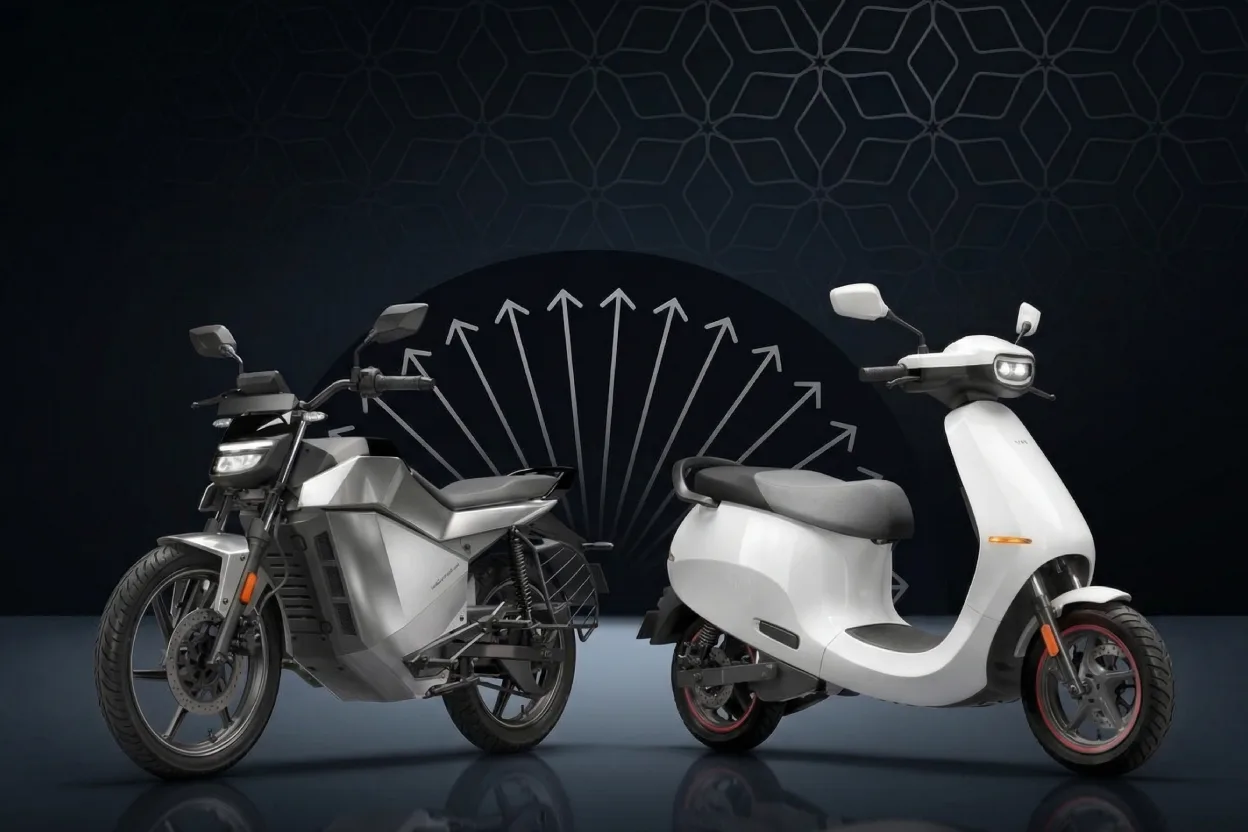
The Indian EV landscape is currently witnessing a high-voltage drama, and at the center of the stage stands Ola Electric. With the Chaitra Navratri festivities kicking off, the automaker has unleashed its “Navratri Mahotsav,” an assertive attempt to dominate the two-wheeler market with benefits purportedly exceeding Rs. 30,000. While the marketing machinery is at full throttle, as an observer of the manufacturing and R&D cycles in this industry, I find the timing and the depth of these discounts both fascinating and slightly concerning.
The “Muhurat” Gambit: Marketing Brilliance or FOMO Engineering?
As per my knowledge, the standout feature of this campaign is the 90-minute daily “Muhurat Mahotsav” slot. During this window, the S1 Pro+ (4 kWh) is being liquidated at a jaw-dropping Rs. 99,999, and the Roadster X+ (4.5 kWh) hits the floor at Rs. 79,999.
In my personal experience with automotive retail, this is a classic “flash sale” tactic designed to create urgency. By restricting the number of units, Ola is effectively bypassing the traditional dealership browsing experience and forcing a rapid conversion. It’s a bold marketing move, but it raises a critical question: is this a genuine celebration of the festival, or a necessary push to clear out specific chassis and battery configurations before the full-scale rollout of the Gen 3 portfolio?
Deep Dive: The Gen 1/Gen 2 vs. Gen 3 Evolution
To understand why Ola is being so aggressive, we have to look at the prototype-to-production evolution of their platforms. The transition from Gen 1 to Gen 3 isn’t just a software update; it’s a fundamental reimagining of the vehicle’s transmission-less architecture and suspension geometry.
| Feature | Ola Gen 1 / Gen 2 | Ola Gen 3 (Current) | My Critical Take |
| Frame/Chassis | Tubular/Hybrid | Integrated Monocoque-style | Gen 3 offers better torsional rigidity and lower weight. |
| Thermal Mgmt | Basic Air/Passive | Advanced Liquid-cooled (Proprietary) | Essential for Indian summers to prevent battery degradation. |
| Suspension | Single Side / Telescopic | Refined Telescopic Front / Mono-rear | Significant improvement in braking stability and ride quality. |
| Software/HMI | MoveOS 2/3 | MoveOS 4+ (Optimized) | Better quality control (SPC) on software bugs that plagued early models. |
I would advise existing Gen 1 and Gen 2 owners to look closely at the Insider Upgrade Program, which has now been expanded to 60% of the customer base. Moving to a Gen 3 model isn’t just about a new marque on the side panel; it’s about moving to a more mature assembly line process that has addressed many of the early R&D hiccups.
Market Comparison: The Battle for the Commuter’s Wallet
Ola isn’t operating in a vacuum. The S1 X and Roadster X series are direct competitors to established makes like TVS and Ather. If we look at the 3-4 kWh segment—the “sweet spot” of the Indian supply chain right now—the competition is fierce.
Segment Comparison Table (Mid-Range EV Scooters)
| Specification | Ola S1 X (4 kWh) | TVS iQube (3.4 kWh) | Ather 450S (2.9 kWh) |
| Ex-Showroom Price | ~Rs. 1,04,999 | ~Rs. 1,35,000 | ~Rs. 1,26,000 |
| Real World Range | ~150-160 km | ~100 km | ~90 km |
| Acceleration (0-40) | 3.3 sec | 4.2 sec | 3.9 sec |
| Warranty | 8 Years (Special Offer) | 3 Years / 50k km | 3 Years / 30k km |
| My Opinion | Best “Spec-to-Price” ratio. | Most “Activa-like” stability. | Superior safety & build. |
As per my opinion, Ola is winning the “Paper War.” On a purely mathematical basis, getting an 8-year extended warranty on a high-tech component like a lithium-ion battery is an undisputed leader in value. However, the repair shop experience and long-term maintenance (tune-ups of the motor and belt drive) still remain the areas where legacy players like TVS hold a slight edge in consumer trust.
The Fine Print: Financing and the “Effective” Price
Ola is leaning heavily into financing and leasing partnerships. With cashback of up to Rs. 10,000 on select credit cards, the effective price of entry-level models is dipping into the territory of high-end internal combustion engines (ICE).
However, I am slightly concerned about the “effective value” vs. “out-of-pocket” cost. While the cash benefit of Rs. 9,999 is straightforward, the long-term value lies in that 8-year warranty. In an industry where a battery replacement can cost 40% of the vehicle’s price, this is a calculated tactical maneuver to de-risk the purchase for skeptical buyers.
Final Thoughts: A Predictive Glance
We are seeing a massive shift in the automaker strategy in India. By offering these Navratri deals, Ola is essentially treating their inventory like consumer electronics—fast-moving, high-discount, and high-volume.
If you are a Gen 1 or Gen 2 owner, this is perhaps the best time to leverage the Upgrade Program. For new buyers, the S1 Pro+ at the “Muhurat” price is a steal, provided you can navigate the digital scrum to secure one.
I would advise potential buyers to not just look at the acceleration and wheels; look at the servicing infrastructure in your specific city. A great price at the dealership is only half the battle; the real test of an EV is the quality control and support you receive two years down the road.