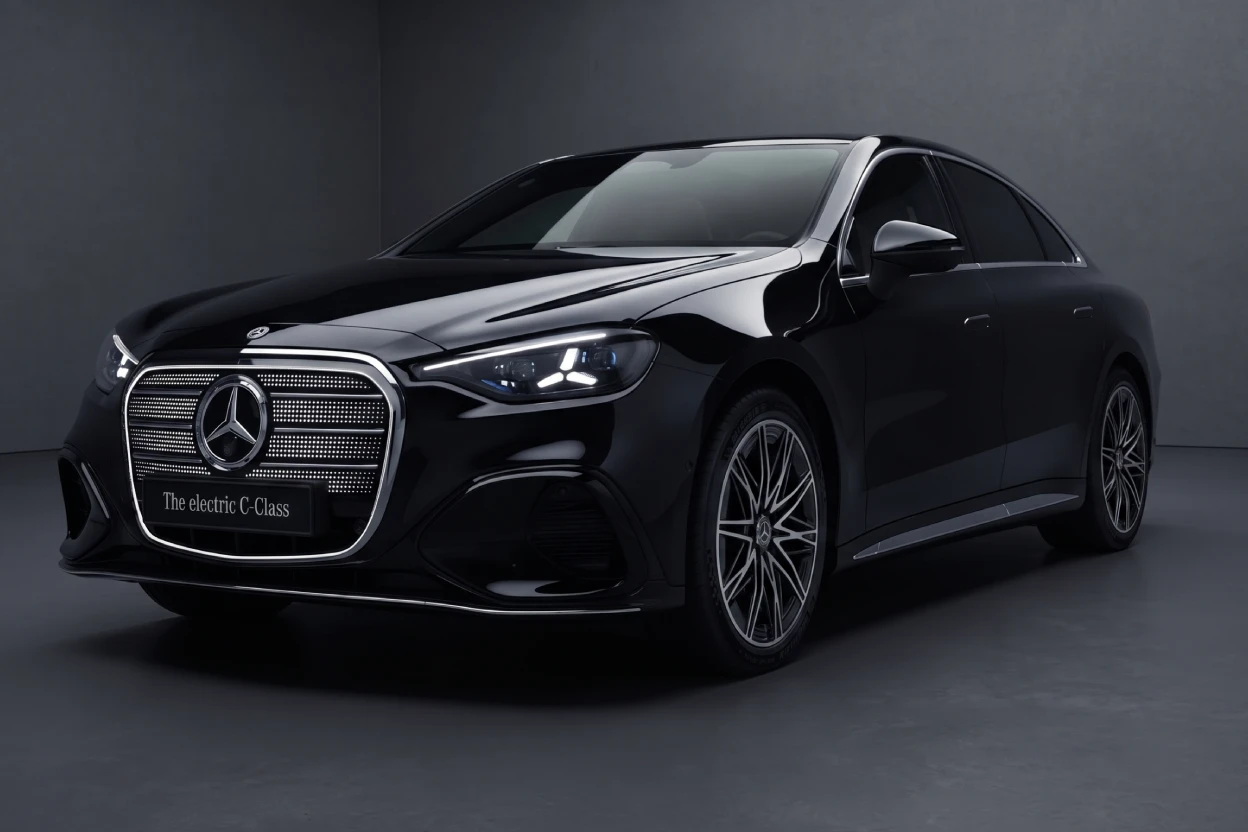
The C-Class has historically been the car that keeps Mercedes’ sales numbers healthy. So going fully electric with it isn’t just a product refresh — it’s a fairly large bet on where the whole business is heading.
Design: Aerodynamics First, Style Second
The new C-Class Electric has a coupe-like silhouette that doesn’t share much visual DNA with its combustion predecessor. The drag coefficient is 0.22 — genuinely low for a sedan this size — and flush door handles, reworked wheels, and a clean underfloor are all doing real work here. The illuminated grille uses over 1,000 micro light elements alongside signature LED lighting. It’s a clear move toward a more digital design language, and it pulls it off better than some of Mercedes’ recent experiments.
Powertrain: The Two-Speed Trick
Base models run a rear-mounted synchronous motor. The C 400 4MATIC trim adds a front motor for AWD, pushing peak output to 482 hp. The 0–96 km/h time is 3.9 seconds.
The interesting call here is a two-speed transmission on the rear axle — you don’t see that often in EVs. First gear handles hard launches; second gear drops motor RPM at highway speeds and saves energy. It probably won’t show up in most reviews, but it makes a real difference over longer drives.
Battery is 94 kWh, WLTP-rated range up to 762 km, and DC fast charging tops out at 330 kW. A 10-minute stop gets you roughly 325 km back. It also accepts both 800V and 400V charging, which matters in markets still sorting out infrastructure.
The Efficiency Systems Worth Knowing About
A multi-source heat pump recycles waste heat from the drivetrain and outside air. Rear-axle steering (up to 4.5°) pulls the turning radius down to 11 meters — surprisingly useful in cities. The regenerative braking system can recover up to 300 kW. None of these make a great headline, but they’re what closes the gap between the claimed range and what you actually see.
Inside: The Screen You’ll Either Love or Find Exhausting
The cabin is built around a 39.1-inch Hyperscreen running MB.OS, Mercedes’ new software platform. It handles infotainment and vehicle controls together, with some AI personalization layered on. Materials are solid — Nappa leather, vegan options, massaging seats, ambient lighting, up to 11 airbags.
The software is the part that keeps me cautious. The hardware will hold up. Whether MB.OS stays responsive three years from now, gets maintained well, and doesn’t turn into a frustrating mess is a question Mercedes hasn’t fully answered based on their software history.
How It Compares
C-Class Electric vs. Previous Petrol C-Class
| Feature | C-Class Electric | Petrol / Diesel C-Class |
| Platform | Dedicated EV | ICE Chassis |
| Powertrain | Dual-motor AWD | Inline-4 / Inline-6 |
| Range | ~762 km | ~600–800 km |
| 0–96 km/h | 3.9 sec | ~6–7 sec |
| Emissions | Zero Tailpipe | $CO_2$ |
Against the Segment
| Model | Power | WLTP Range | 0–100 km/h | Battery |
| Mercedes C-Class Electric | 482 hp | ~762 km | 3.9 sec | 94 kWh |
| Tesla Model 3 LR | ~498 hp | ~629 km | 4.4 sec | ~82 kWh |
| BMW i4 eDrive40 | 335 hp | ~590 km | 5.7 sec | ~83.9 kWh |
| Hyundai Ioniq 6 | 320 hp | ~614 km | 5.1 sec | ~77.4 kWh |
The range and charging speed numbers are hard to beat in this class. Whether that outweighs Tesla’s charging network reach or the BMW’s driving feel comes down to what you actually use the car for.
Things Worth Thinking About Before Buying
Fast charging availability varies a lot depending on where you live. Real-world range will be lower than WLTP under cold weather, highway speeds, or heavy climate control use. And keep the software question in mind — MB.OS is brand new, and new software in cars tends to have a rough first year or two.