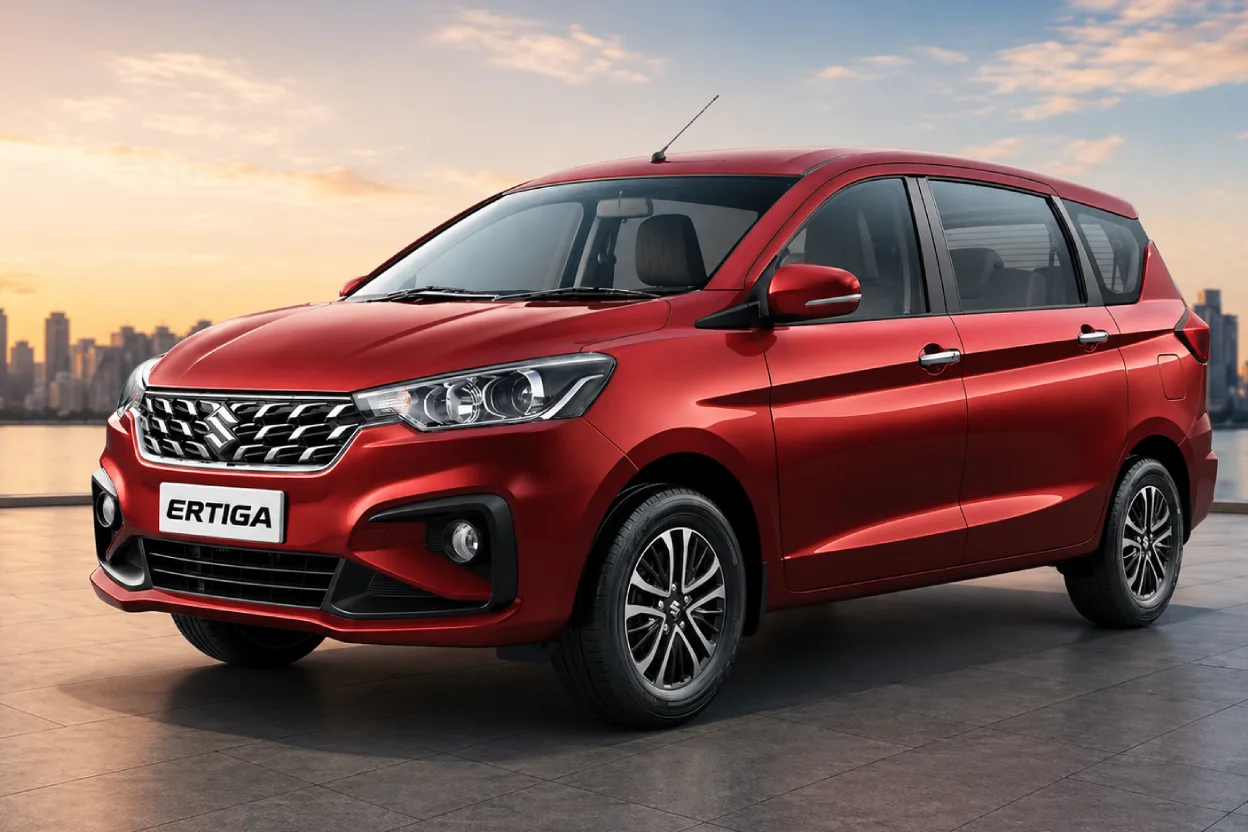
The Indian car market is supposedly all about SUVs now. The data, for the most part, backs that up. And yet the vehicle that came closest to cracking 2 lakh annual sales wasn’t a compact SUV — it was a seven-seater people-mover that debuted when Gangnam Style was charting.
Maruti moved 1,98,876 Ertigas in FY26. That’s a 4% increase year-on-year. For context, Toyota’s full MPV lineup — Innova Crysta and Hycross together — did around 1.12 lakh units in the same period. The Ertiga, on its own, nearly doubled that.
I genuinely didn’t expect that number when I started looking at FY26 segment data. I probably should have.
What Maruti Got Right
There’s no clever secret here. The Ertiga fits in a city parking spot and also fits seven adults in it. The factory-fitted CNG option makes the running costs low enough that fleet operators and private buyers end up in the same showroom, for the same reasons. The 1.5-litre petrol engine — 103 bhp, 137 Nm — is not exciting. It is, however, extremely difficult to break. For a lot of buyers, that combination is enough.
The 6-speed automatic was the real turning point. The old 4-speed unit made the Ertiga feel like exactly what it was: a practical purchase, not a preferred one. Once they replaced it with a proper 6-speed torque converter with paddle shifters, something shifted. It stopped being the car people bought because they needed seven seats and started being the car people bought because they wanted it.
The Competition, Honestly
The Kia Carens is more feature-packed. The Renault Triber is cheaper. The Innova Hycross is more luxurious and costs nearly three times as much. None of them are competing for the same buyer at the same price in the same way — which is either a sign of how well Maruti positioned this thing, or a sign that nobody else has bothered to try seriously.
| Model | Price Range | What It’s Actually For |
| Maruti Ertiga | ₹8.79 – ₹12.94 Lakh | Running costs, resale, volume |
| Kia Carens | ₹10.50 – ₹19.50 Lakh | Features, turbo performance |
| Renault Triber | ₹6.00 – ₹9.00 Lakh | Budget, flexible seating |
| Toyota Innova Hycross | ₹19.00 – ₹30.00+ Lakh | Luxury, strong hybrid |
Behind the Wheel
I ran a long trip in the current model recently — six passengers, summer, bad roads in stretches. The suspension handles broken tarmac better than you’d expect at this price. The roof-mounted rear vents actually push cold air to where people are sitting, which sounds like a low bar but several cars in this segment fail it.
The honest caveat: when the car is full, the 1.5-litre engine requires planning. Highway overtakes need thought. You telegraph your intentions in advance or you wait for a longer gap. It’s not a problem if you know it going in — it becomes one if you’re expecting something it isn’t.
Whether It Can Keep Growing
The mild hybrid system helps fuel economy at the margins. It doesn’t change the conversation the way a strong hybrid does. If petrol prices keep climbing — or if Toyota manages to bring the Hycross’s hybrid tech into a cheaper package — Maruti will have to respond with something.
But right now, the Ertiga’s supply chain works, the dealer network covers places competitors don’t reach, and the resale values hold. Nearly two lakh buyers in FY26 made the same call independently of each other. Most of them probably aren’t wrong.